
Not exactly. A debt doesn’t vanish when someone dies, but it doesn’t pass to their family either. It stays with the estate, meaning the money and property they left. The Consumer Financial Protection Bureau (CFPB) puts it this way: “When someone dies, their debts are generally paid out of the money or property left in the estate.” And if that isn’t enough: “If the estate can’t pay it and there’s no one who shared responsibility for the debt, it may go unpaid.”
This page is general information, not legal or tax advice. Estate law varies by state and changes. Ask the court clerk, or a lawyer or tax professional, about your case.
So most relatives owe nothing from their own money. A few people can still owe, and an inheritance can shrink because debts come first. This page is part of our guide to debts, accounts and taxes after a death. It explains what happens to your debt when you die: who can still owe, each kind of debt, the order bills get paid, how long creditors have, and what to say when a collector calls.
Who still owes it, debt by debt
The short version. The details and sources for each row are further down.
| Debt | After the death | Who can still owe it |
|---|---|---|
| Credit card | A claim against the estate | The estate; a joint account holder. Not an authorized user |
| Federal student loan | Discharged once the death is proved | Generally no one, with two narrow exceptions below |
| Private student loan | Depends on the contract and its date | The estate; a co-signer on an older loan, if the contract says so |
| Mortgage | Stays attached to the house | The estate; anyone else who signed the loan. An heir who didn’t sign generally isn’t personally liable, but the lender can still foreclose if it isn’t paid |
| Reverse mortgage (HECM) | Comes due after the last borrower and any eligible non-borrowing spouse have died | Repaid from the home. If it’s worth less than the loan, mortgage insurance covers the gap on a qualifying sale |
| Car loan | The lender’s lien stays on the car | The estate; any co-signer |
| Medical bills | A claim against the estate | The estate; a spouse in some states |
| Nursing home bills | A claim against the estate | The estate; possibly anyone who took on the debt personally, or a relative under a state support law |
| Medicaid long-term care | The state may seek repayment | The estate, which some states define to include property that skipped probate |
| Federal income tax | A debt of the estate | The estate; a spouse on a joint return; an executor in the narrow case below |
Who can still owe
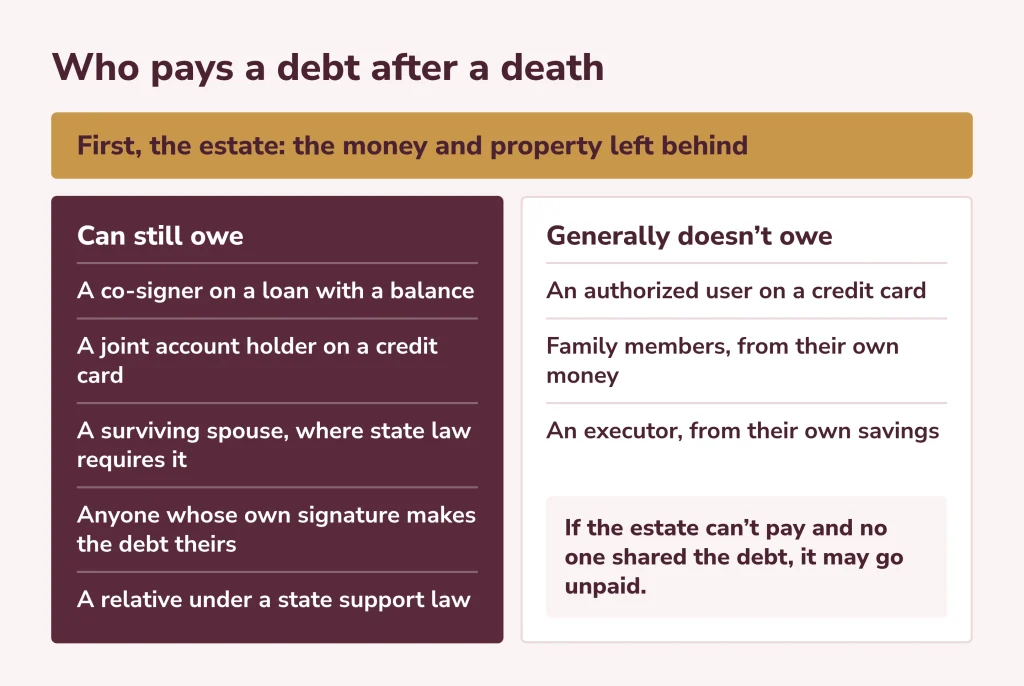
Can you inherit debt from a parent? Generally not. The FTC says “family members usually don’t have to pay the debts of a deceased relative from their own money.” The CFPB’s list of people who may have to pay is short:
- Co-signers. Someone who co-signed a loan with a balance still on it.
- Joint account holders on a credit card. An authorized user, who could only use the card, isn’t responsible for the balance.
- Surviving spouses, where state law requires it. A small number of states have necessaries laws, which can make a spouse responsible for things like healthcare.
- Surviving spouses in community property states. Some of these states require jointly held property to be used for a deceased spouse’s debts. The CFPB lists Alaska (with a special agreement), Arizona, California, Idaho, Louisiana, Nevada, New Mexico, Texas, Washington and Wisconsin.
- An executor or administrator, in a limited way. Some states require bills to be paid from property held jointly with a deceased spouse. That concerns the property, not the executor’s own savings.
Two more are easy to miss. The first is your own signature. The CFPB’s guide for surviving spouses says: “You are responsible if the debt is also yours.” That logic reaches paperwork signed after a death too, so it pays to read a funeral home contract for any line making the signer personally responsible.
The second is a family support law, sometimes called filial responsibility. Pennsylvania’s 23 Pa.C.S. 4603, read on 5 Nov 2026, gives an indigent person’s spouse, children and parents “the responsibility to care for and maintain or financially assist” them, unless the relative lacks the financial ability. A child isn’t liable for a parent who abandoned them for 10 years of their childhood. A CFPB circular, since withdrawn, noted that some nursing facilities may claim family members are responsible under laws of this kind. We didn’t survey other states. A letter citing one is a good moment to talk to a lawyer.
How the estate pays
An executor is the person a will names to wind up the estate. If there’s no will, a court usually appoints an administrator. “Personal representative” covers both. The IRS describes the job as “to collect all the decedent’s assets, pay the decedent’s creditors, and distribute the remaining assets to the heirs or other beneficiaries.” Debts generally come before heirs.
Taking the job doesn’t put your savings on the line. The CFPB says that being the representative means using estate assets to settle debts, and it “does not make you responsible for paying the debt with your own money.” The exceptions are near the end of this page.
When an estate can’t pay everything, state law sets the order. There is no national list. Here is Florida’s, Fla. Stat. 733.707, read on 5 Nov 2026, as one example:
- Costs of administering the estate, including the personal representative’s pay and attorneys’ fees
- Reasonable funeral, burial and grave marker costs, up to $6,000
- Debts and taxes with preference under federal law, and certain state claims
- Reasonable and necessary medical and hospital costs of the last 60 days of the final illness
- Family allowance
- Unpaid court-ordered child support
- Debts from continuing the person’s business after death, limited to that business’s assets
- All other claims, plus anything above the limits in classes 2 and 4
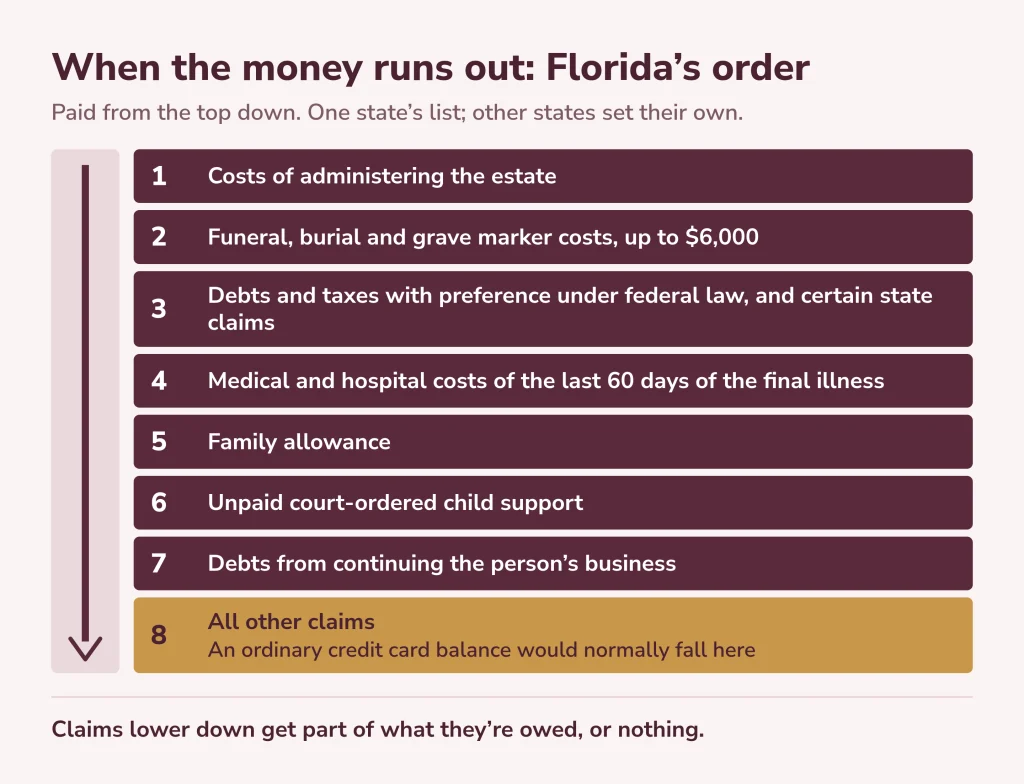
An ordinary credit card balance would normally fall in that last class. You may read that medical bills get paid first. In Florida, only the last 60 days of care get a place, and it’s fourth. Other states set their own order, so the probate court clerk is the place to ask.
When the money runs out, the claims lower down get part of what they’re owed or nothing. No one has to make up the difference unless one of the exceptions above applies.
How long creditors have
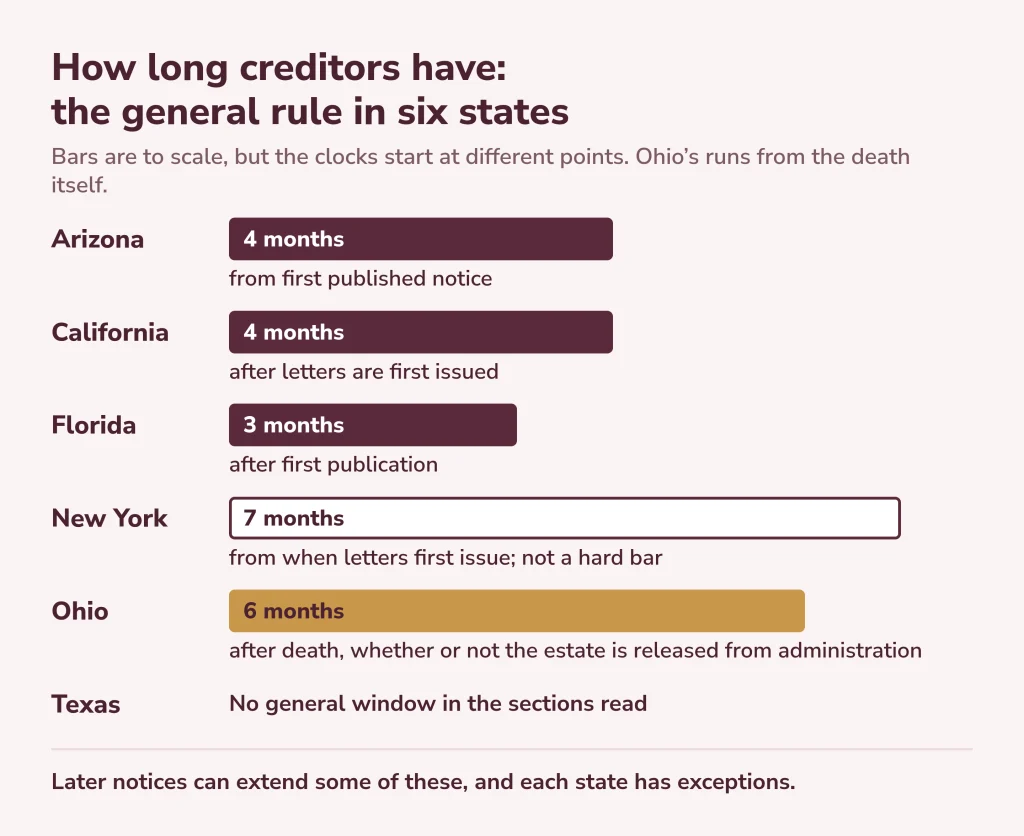
There’s no national deadline. Many states run a claims process: the representative gives notice, and creditors who miss the window can lose the claim. These rows were read on 5 Nov 2026 and give the general rule. Each has exceptions.
| State | Window for most claims | Statute |
|---|---|---|
| Arizona | 4 months from first published notice, or 60 days from mailed notice if later. Outer limit 2 years after death, plus any time left in a notice period | A.R.S. 14-3801, 14-3803 |
| California | The later of 4 months after letters are first issued or 60 days after notice is mailed or personally delivered to the creditor. Lawsuits on the person’s debts generally within 1 year after death | Prob. Code 9100, CCP 366.2 |
| Florida | The later of 3 months after first publication or 30 days after service on the creditor. After 2 years from death, the estate, representative and beneficiaries are generally not liable | Fla. Stat. 733.702, 733.710 |
| New York | 7 months from when letters first issue. Not a hard bar: it protects a fiduciary who paid others in good faith before the claim arrived | SCPA 1802 |
| Ohio | 6 months after death, whether or not the estate is released from administration or anyone is appointed (read 5 Nov 2026 in the official Ohio code) | ORC 2117.06 |
| Texas | No general window in the sections read. Notice to creditors is published within a month of letters. An unsecured creditor sent the optional notice has until before the 121st day after receiving it | Est. Code 308.051, 308.054, 355.060 |
“Letters” here means the court papers that give the representative authority. Two things follow from these rows. Windows tied to letters or notice only start once someone opens a case, while limits like Ohio’s and California’s one year run from the death itself. And a lien isn’t a claim in the same sense: Florida’s deadlines don’t affect a proceeding to enforce a mortgage or other lien, and its two-year cutoff leaves recorded mortgages alone.
Ordinary time limits still apply too. A debt collector must not sue or threaten to sue on a debt whose limit has expired. The CFPB also warns that “making a partial payment or acknowledging you owe an old debt, even after the statute of limitations expired, may restart the time period.” The FTC says the same of paying, or promising to pay, in some states.
Property that skips the estate
Some property passes outside probate, the court process for settling an estate: life insurance paid to a named person, accounts with a beneficiary or survivor, a house with a transfer-on-death deed. You may read that creditors can’t touch any of it. That’s too broad. It’s a state law question, and the answers differ. These examples were read on 5 Nov 2026.
- Florida, life insurance (Fla. Stat. 222.13). For a Florida resident, proceeds paid to a named person are “exempt from the claims of creditors of the insured”, unless the policy or an assignment says otherwise. If the policy pays the estate, the money is handled as part of the estate.
- Arizona and Maine, other transfers. If the probate estate can’t cover allowed claims and allowances for the spouse and children, people who received certain non-probate transfers can be made to contribute, up to the value they received. Survivorship in jointly held real estate is left out. A proceeding must generally start within 2 years after death in Arizona (A.R.S. 14-6102) and 1 year in Maine (18-C M.R.S. 6-102).
- California, small estates (Prob. Code 13109). Someone who collects property by affidavit is “personally liable” for the person’s unsecured debts, capped at the value of what they received less liens. A small estate affidavit is a shortcut around court, not around debts.
- Medicaid. A state may define the estate to reach assets passed by joint tenancy, survivorship, life estate or living trust.
Each kind of debt
Credit cards
The balance is a claim on the estate. A federal rule, Regulation Z, 12 CFR 1026.11(c), gives an executor or administrator three useful protections:
- A balance on request. You can ask by phone or in writing. An answer within 30 days counts as timely.
- A freeze on fees. After the request, the issuer can’t add fees such as late or annual fees, and generally can’t raise the rate.
- Interest relief. If the full balance it gave you is paid within 30 days of telling you, the issuer must waive or rebate interest added after that disclosure. The rule’s own example: request on March 1, a $1,000 balance disclosed March 25, paid by April 24.
Fees and interest from before the request can stand, so its date matters. The issuer may ask for proof of your authority and may close the account once told of the death. These protections don’t apply while a joint account holder remains. Before any card is paid in full, it’s worth checking that the estate can cover the claims ahead of it.
Student loans
Federal loans end at death. Under 34 CFR 685.212, the Education Department discharges a Direct Loan when the borrower dies, and a parent’s Direct PLUS Loan when the parent or the student dies. Proof can be a death certificate or a check of an official database. The federal aid handbook says the same discharge exists for FFEL and Perkins loans. The servicer is the one to tell.
Two exceptions are narrow but real. On an older joint consolidation loan taken out by a married couple, only the part tied to the deceased borrower is discharged (34 CFR 685.220(l) for Direct Loans, 682.402(a)(2) for FFEL). And if two parents took out a FFEL PLUS loan as co-makers and one dies, the other generally stays liable (682.402(a)(3)).
Private loans depend on the contract and its date. For agreements made on or after 20 November 2018, 180 days after the 2018 law, 15 USC 1650(g) says the holder, once told the student has died, must release any co-signer within a reasonable time. It also bars a lender from declaring default against the student just because a co-signer died. Older contracts are governed by their terms and lender policy, which we didn’t survey. The law’s wording covers the co-signer. It doesn’t say the claim against the student’s estate ends, so ask the lender.
Mortgages
The loan stays on the house. Anyone who also signed it, such as a spouse on the loan, still owes it, because the debt is theirs too. An heir who didn’t sign “is not personally liable for the associated debt, but may choose to assume the debt,” as the CFPB put it in a July 2014 bulletin. The CFPB withdrew that bulletin on 12 May 2025, along with dozens of other guidance documents, so treat the line as the agency’s earlier view. The Garn-St Germain Act stands, and it stops a lender from using a due-on-sale clause on a home of fewer than five units after a transfer to a relative resulting from the borrower’s death, or on the death of a joint tenant. The federal regulation adds that the relative must occupy or plan to occupy the home. If an heir doesn’t plan to live there, that’s worth raising with the servicer early.
The payments still have to be made, or the lender can foreclose. Once the servicer confirms your identity and ownership, you become a confirmed successor in interest under federal mortgage servicing rules. Options for the house are in our guide to selling a house in probate.
Reverse mortgages
A Home Equity Conversion Mortgage (HECM), the federally insured kind, comes due after the last borrower and any eligible non-borrowing spouse have died. The CFPB says heirs get 30 days from the due-and-payable notice to buy the home, sell it or hand it over, and that this may stretch to six months. HUD’s 2019 sheet counts the 30 days from the death and mentions 90-day extensions, so read the lender’s notice closely.
Keeping the home is less clear. The CFPB’s heirs page and HUD’s sheet say the balance must be paid in full, but another CFPB page says heirs repay the full balance or 95 percent of the appraised value, whichever is less. Ask the servicer for the figure in writing. To sell when the loan is larger than the home’s value, a price of at least 95 percent of the appraised value can settle it, with mortgage insurance covering the rest. A non-borrowing spouse has separate rules that depend on when the loan was made.
Car loans and other secured debts
A secured lender has a claim on the thing itself. The lien stays on the car whoever inherits it, and if the estate or a co-signer doesn’t pay, the lender can enforce it. Claim deadlines may not end that right: Arizona’s statute, like Florida’s, leaves proceedings to enforce a lien alone. Other states set their own rules. The lender can tell you what it needs from the estate.
Medical bills and nursing homes
Medical bills go to the estate like other claims, subject to the spouse rules above. Nursing home bills are more complicated, because the admission contract is often signed by a relative.
Federal law bars a nursing home that takes Medicare or Medicaid from requiring a third-party guarantee of payment as a condition of admission or continued stay, and the regulation bars requesting one. A facility can require someone with legal access to the resident’s money to sign a contract to pay from the resident’s funds, but “without incurring personal financial liability.” Even so, the CFPB found “Responsible Party” clauses in some contracts that can lead relatives to believe they owe.
One caution. A 2022 CFPB circular called provisions breaking this rule illegal and unenforceable. The CFPB withdrew that circular on 12 May 2025, in a notice saying the withdrawal wasn’t necessarily final. The statute itself didn’t change. Whether a particular clause binds a particular relative is a question for a lawyer or legal aid office, and state support laws are a separate issue.
Medicaid
Medicaid can act as a creditor. For people 55 or older, states must seek recovery from the estate for nursing facility care, home and community-based services, and related hospital and drug costs. States can’t recover while a spouse, a child under 21, or a blind or disabled child of any age survives, and they must have a hardship waiver process. See whether Medicaid can take the house for how that works.
Taxes
Unpaid federal tax is a debt of the estate. A surviving spouse who signed a joint return can owe it too, because liability on a joint return is “joint and several” under 26 USC 6013(d)(3). The returns themselves are covered in filing taxes for someone who died.
When a collector calls
Collectors can contact families. What they can say depends on who you are. These rules come from the Fair Debt Collection Practices Act and Regulation F, and they bind debt collectors. A creditor’s own staff collecting its own debt fall outside them, though the FTC notes many states have their own collection laws.

- Spouse, parent of a minor, guardian, executor or administrator, confirmed successor to a home. A collector can discuss the debt with you. That doesn’t mean you owe it. It’s not legal for them to state or imply that you must pay from your own assets unless an exception fits.
- Anyone acting for the estate without a court appointment. The official commentary lists people who sign affidavits to transfer estate assets as possible personal representatives, so small estate users can count too.
- Other relatives. A collector can call to find who’s handling the estate, generally once, and shouldn’t discuss the debt with you.
You can use these rights:
- Ask for details in writing. The collector must give validation information, on the first call or within five days. If the person has died, it goes to a named person authorized to act for the estate. The CFPB says a collector who refuses to give details to a spouse or representative may be a scam.
- Dispute it. A written dispute within 30 days of receiving the validation notice makes the collector stop until it validates the debt.
- Tell them to stop. Send a letter or email and keep a copy, since a phone call isn’t enough. After that, they may confirm they’re stopping or say they plan a specific step, such as a lawsuit. The debt doesn’t go away, and it can still be pursued against the estate.
- Complain. To the CFPB, the FTC or your state attorney general.
Where an executor can get caught
Being an executor doesn’t make the debts yours. Mishandling the estate can. The FTC says someone legally responsible for an estate may be personally responsible if they didn’t follow certain state probate laws. One risk to ask about is paying out too early: heirs before creditors, or low-priority creditors before higher ones. State rules differ. See how long an executor has to pay beneficiaries.
The sharpest risk is federal. When an estate can’t pay all its debts, 31 USC 3713 says a claim of the US “shall be paid first.” A representative “paying any part of a debt of the person or estate before paying a claim of the Government” is “liable to the extent of the payment for unpaid claims of the Government.” The IRS manual says this applies where the fiduciary knew of the tax debt, and limits it to the value of what was paid out. IRS Publication 559 adds notice and due care: the representative is responsible if they “had notice of such tax obligations or failed to exercise due care” in checking for them.
Outside bankruptcy, the statute lists no exception. The IRS’s manual says courts have let certain claims go first, including administrative expenses, funeral expenses and family allowances, and that the IRS may cede priority in limited circumstances. The manual guides IRS staff and isn’t law, and courts can differ on the details.
Two forms help when the job winds down. Form 4810 asks for a prompt assessment, cutting the IRS’s window to 18 months from the request on most returns. It doesn’t cover the estate tax return, and it doesn’t shorten the window where substantial income went unreported or a return was fraudulent. Form 5495, filed after the returns, asks for discharge from personal liability. Within 9 months the IRS names the amount due, and paying it, or hearing nothing, discharges an executor or administrator appointed and acting in the US. It doesn’t protect estate property the executor still holds.
These are the points to get a lawyer: an estate that may not cover its debts, especially with an IRS debt; a lawsuit or a deadline running; a nursing home or support-law claim against a relative; a business; or a conflict between heirs.
What to do next
Most of this can wait until you know what the estate holds. Mortgage and car payments, insurance on the house and any court deadline can’t wait as long. Gather these first:
- A list of every bill and statement that comes in. A credit report helps: the CFPB suggests telling Equifax, Experian and TransUnion about the death and asking for a copy.
- Anything the person signed with someone else: co-signed loans, joint cards, a nursing home contract.
- A rough total of what the estate holds, and what passes outside it.

Then ask the county probate court clerk how creditor claims work in your state, and whether anyone has been appointed yet. If a collector calls in the meantime, you can ask for everything in writing.
Sources checked on 5 November 2026.
Sources
- CFPB: Does a person's debt go away when they die? (reviewed 15 Oct 2026)
- CFPB: Can a debt collector contact me about a deceased relative's debts? (reviewed 19 Oct 2023)
- CFPB: When a loved one dies and debt collectors come calling (page modified 22 Sep 2026)
- CFPB: Surviving spouse booklet
- CFPB: Can debt collectors collect a debt that's several years old? (reviewed 28 Oct 2026)
- CFPB: With a reverse mortgage loan, can my heirs keep or sell my home? (reviewed 28 Aug 2026)
- CFPB: Reverse mortgage balance larger than the home's value (reviewed 11 Jul 2022)
- CFPB: What happens to my reverse mortgage when I die? (reviewed 2 Jan 2025)
- FTC: Debts and Deceased Relatives (Feb 2023)
- FTC: Debt Collection FAQs (Mar 2023)
- Regulation F, 12 CFR 1006.2
- Regulation F, 12 CFR 1006.6 and commentary
- Regulation F, 12 CFR 1006.10 and commentary
- Regulation F, 12 CFR 1006.26
- Regulation F, 12 CFR 1006.34 and commentary
- Regulation Z, 12 CFR 1026.11(c) and commentary
- Regulation X, 12 CFR 1024.31
- CFPB bulletin on successors in interest, July 2014 (withdrawn 12 May 2025)
- 12 USC 1701j-3(d), Garn-St Germain Act
- HUD: Inheriting a Home Secured by an FHA-insured HECM (Sep 2019)
- 31 USC 3713
- IRS Internal Revenue Manual 5.17.13
- IRS Publication 559, Survivors, Executors, and Administrators
- 26 USC 6013(d)(3)
- 15 USC 1650(g), with the 2018 effective date note
- 34 CFR 685.212, discharge of a loan obligation
- 34 CFR 685.220(l), joint consolidation loans
- 34 CFR 682.402(a), FFEL death discharge
- Federal Student Aid Handbook 2023-2024, Appendix B
- 42 USC 1396r(c)(5)
- 42 CFR 483.15
- CFPB Circular 2022-05, withdrawn 12 May 2025
- CFPB Issue Spotlight: Nursing Home Debt Collection (Sep 2022)
- 12 CFR 191.5, due-on-sale limits
- Federal Register, 12 May 2025: CFPB withdrawal of guidance documents (lists Circular 2022-05 and the July 2014 bulletin)
- 23 Pa.C.S. 4603
- Medicaid.gov: Estate Recovery
- 42 USC 1396p(b)
- Fla. Stat. 733.707 (2026)
- Fla. Stat. 733.702 (2026)
- Fla. Stat. 733.710 (2026)
- Fla. Stat. 222.13 (2026)
- Cal. Prob. Code 9100
- Cal. Code Civ. Proc. 366.2
- Cal. Prob. Code 13109
- N.Y. SCPA 1802
- Tex. Est. Code ch. 308
- Tex. Est. Code ch. 355
- Ohio Rev. Code 2117.06, effective 3 Apr 2023 (read 5 Nov 2026 in the official Ohio code)
- A.R.S. 14-3801
- A.R.S. 14-3803
- A.R.S. 14-6102
- 18-C M.R.S. 6-102