
An executor can’t change the will, decide who deserves what, or treat estate money as their own. They can’t buy estate property for themselves without permission, act before the court appoints them, or pay debts in whatever order suits them. Their job is to carry out the will and the law for the people entitled to the estate. A person with that kind of legal duty is called a fiduciary.
This page is general information, not legal or tax advice. Estate law varies by state and changes. Ask the court clerk, or a lawyer or tax professional, about your case.
Most of these limits have an exception, usually the will, the agreement of everyone affected, or a court order. That’s why the answer to “can they do that?” is so often “who gave permission?” This guide belongs to our section on the executor’s job. It’s for executors who want to stay on the right side of the line, and for families who think someone has crossed it. An administrator, the person a court appoints when there’s no will, generally works under the same rules. Many statutes call both a “personal representative.”
There’s no single national rulebook. The examples below come from California, Florida, Illinois, Minnesota, New York and Texas. Each names its statute. All were read on 5 November 2026, Illinois in the General Assembly’s public file repository. Minnesota’s sections follow the Uniform Probate Code, a model law, so they show a common pattern. Your state’s version may differ.
The short list
| An executor generally can’t | What can change that |
|---|---|
| Run the estate before being appointed | Funeral costs and protecting property, in some states |
| Change the will or who inherits | Nothing the executor can do alone; all affected heirs may agree among themselves in some states |
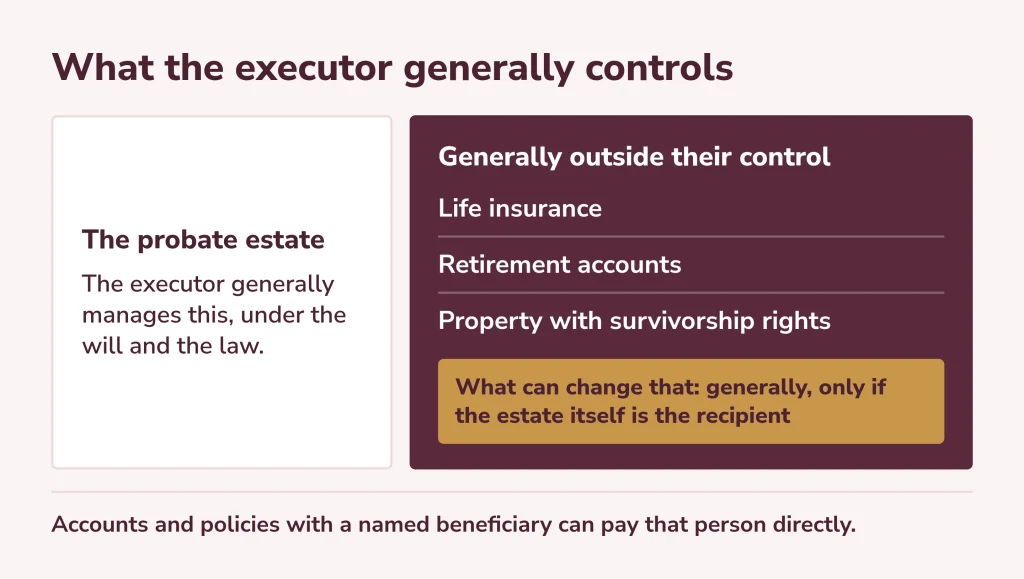
| Control life insurance, retirement accounts or property held with survivorship rights | Generally, only if the estate itself is the recipient |
| Buy estate property or deal with themselves | The will, a contract the person signed, or a court, depending on the state |
| Mix estate money with their own | Very little; New York’s narrow exceptions cover securities held in a bank nominee’s name |
| Set and take any pay they like | The will, the state’s schedule, or the court |
| Pay debts and heirs in any order | Nothing; state law and federal law set the priorities |
| Ignore beneficiaries’ rights to notice and information | The rules differ by state, but none read here allows silence |
| Act alone when there’s a co-executor | The will, a court, or state rules on majorities and emergencies |
| Simply walk away once appointed | A resignation the court or state process accepts |
Act before being appointed
Being named in a will is a nomination, not a job. California Probate Code 8400 is blunt: “A person has no power to administer the estate until the person is appointed personal representative and the appointment becomes effective.” That happens when letters are issued. The court’s order must even carry a capitalized warning saying so. Letters are the court paper that proves authority.
There’s a small opening. The same section lets a California named executor pay funeral expenses and take necessary steps to maintain and preserve the estate before appointment. Minnesota 524.3-701 lets a named executor carry out the person’s written instructions about the body, funeral and burial. It and Florida 733.601 also give later effect to earlier acts, by the person later appointed, that benefited the estate. None of that lets a named executor sell a car or empty a bank account on the strength of the will alone.
Change the will or decide who gets what
An executor can’t. Florida 733.602 requires the estate to be settled and distributed under the will and the probate code. If there’s no will, state law names the heirs. The executor’s opinion of who helped most, or who needs the money, doesn’t count.
Unless the will says otherwise, a person left a particular item is entitled to that item (Minnesota 524.3-906). Some wills do give the executor a choice, such as dividing household items among the children. That power comes from the will, so it goes only as far as the will’s words.
Favoritism has limits too. Florida holds an executor to the standards of care that apply to trustees, and its trust code says a trustee “shall act impartially” among beneficiaries.
The beneficiaries have more room than the executor does. Under Minnesota 524.3-912, competent heirs and beneficiaries can change their shares by written contract signed by everyone affected, and the executor must follow it. Creditors’ and tax claims still come first.
Can an executor also be a beneficiary? Yes, and it’s common. Minnesota’s priority list for appointment puts a surviving spouse who inherits under the will, then other people who inherit under it, right after anyone the will names. An executor who inherits takes their share as a beneficiary, and still can’t enlarge it as executor.
Control what passes outside the will
The executor generally manages the probate estate, not everything the person owned. Accounts and policies with a named beneficiary can pay that person directly. The IRS’s manual, for one, lists life insurance proceeds and property held jointly with the right of survivorship among the assets not subject to probate. Survivorship means the surviving owner takes it all. A share owned without that right can still be part of the estate.
A US Supreme Court case shows how firm this can be. In Kennedy v. Plan Administrator for DuPont Savings and Investment Plan (2009), a daughter, as executor, brought the estate’s suit over a retirement plan that paid her father’s ex-wife. The divorce papers had given up the ex-wife’s interest, but her name was still on the plan’s form. The executor lost: the Court held that the plan administrator had done its duty by paying the ex-wife as the plan documents said. The plan fell under ERISA, the federal law covering most private employer plans, so accounts outside it may follow other rules.
Buy from the estate or deal with themselves
You may read that an executor can buy estate property as long as they pay fair market value. In the states below, as read on 5 November 2026, a fair price alone isn’t the test. Permission is.
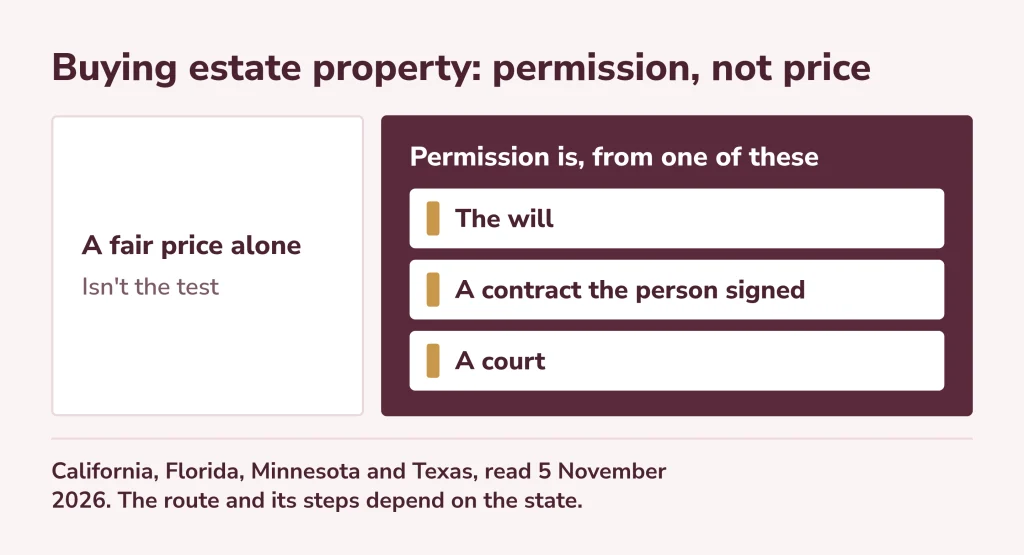
| State | The rule | What allows the deal |
|---|---|---|
| California, Prob. 9880, 9881, 9884, 9885 | Neither the executor nor their attorney may buy estate property or a claim against the estate, directly or indirectly | Court order, with written consent of each affected heir and beneficiary and a showing that it helps the estate; or an enforceable contract made in the person’s lifetime; or an option in the will (each with its own court steps) |
| Florida, 733.610 | A sale to the executor, their spouse, agent or attorney, or a deal affected by their conflict of interest, is voidable: an interested person can have it undone | The will or a contract the person signed expressly allows it; or a court approves after notice. Anyone who consented after fair disclosure can’t object |
| Minnesota, 524.3-713 | Much the same as Florida, though the general conflict test says a “substantial” conflict | The same three routes |
| Texas, Est. Code 356.651 to .654 | The executor “may not purchase, directly or indirectly, any estate property” they or a co-executor sell | A probated will that expressly allows it; a written contract the person signed; or a court finding that it’s in the estate’s best interest, after notice |
Texas generally lets independent executors act without court orders (Est. Code 402.002). Its best-interest route names independent administrators, but how far the rest of the purchase rule binds an independent executor is not confirmed, so ask the court.
Conflicts go beyond buying. Hiring your own company to clear the house or renting the house to your son can raise the same question. Florida’s rule reaches a transaction affected by a conflict of interest, and Minnesota’s one affected by a substantial conflict. Minnesota does let an executor employ helpers “even if they are associated with the personal representative” (524.3-715), and a court can still review that hiring and its cost (524.3-721). California’s independent administration, the route with less court supervision, still requires court supervision for a sale to the executor or their attorney, and for settling claims between the executor and the estate.
Mix estate money with their own
New York EPTL 11-1.6 says it plainly: “Every fiduciary shall keep property received as fiduciary separate from his individual property.” Transactions must be made in the fiduciary’s name as fiduciary, and a violation of the section is a misdemeanor. That’s the reason for a separate estate account, which starts with a tax number for the estate. Even a bill paid from a personal card for convenience needs a paper trail, so that any repayment can be justified later.

Helping yourself to the car, the house or the account, with no right to it under the will, is a similar problem. Under California Probate Code 9601, an executor who breaches a fiduciary duty can be charged with the estate’s loss or any profit they made, with interest.
Risky investing has limits too. Minnesota 524.3-715 allows investing only funds not needed for debts and expenses or for immediate distribution, in insured accounts or other prudent investments reasonable for trustees generally. California 9730 lists short-term choices such as US or California obligations maturing within a year and certain registered money market funds.
Set their own pay without limits
Executors can usually be paid, but the amount and timing aren’t theirs alone to decide. Our executor fee estimate shows the schedules. The timing rules differ more than people expect (all read 5 November 2026):
- California: pay needs court supervision. A petition for an allowance on pay can be filed from four months after letters are issued.
- New York: the route for an advance on commissions is a court petition, under SCPA 2310 or 2311, usually with a bond securing repayment if the payment is disallowed.
- Minnesota and Florida: a court can review pay and order refunds of anything excessive (524.3-721, 733.6175). In Florida the executor carries the burden of showing the pay was reasonable.
Fees aren’t a tax-free extra. The IRS’s Publication 559 (2025) says personal representatives “must include fees paid to them from an estate in their gross income.”
Pay debts and heirs in the wrong order
This is where an executor’s own money can come into it. The Consumer Financial Protection Bureau says being the personal representative “does not make you responsible for paying the debt with your own money“, unless the debt is also yours. Debts come out of the estate, as we explain in what happens to debt after a death. Paying the wrong people first is a separate risk.
When an estate can’t pay everything, federal law puts the US first. Under 31 USC 3713(b), a representative “paying any part of a debt of the person or estate before paying a claim of the Government is liable to the extent of the payment for unpaid claims of the Government.”
Three things limit that. The IRS’s manual, which guides its staff and isn’t law, says personal liability arises only if the estate is insolvent, that knowledge of the claim is required (facts that would put a reasonably careful person on notice can count), and that liability is capped at the assets paid out against the priority. It also says courts have let certain claims go first, including administrative expenses, funeral expenses and family allowances, though the statute lists no exception, and that a federal tax lien arising before death still comes ahead of funeral costs and family allowances. That isn’t a guaranteed safe harbor, and it doesn’t settle the question in every court. Publication 559 adds that the representative of an insolvent estate can be responsible if they had notice of the tax or “failed to exercise due care” in finding out whether it was owed.
Other creditors matter too. Under Minnesota 524.3-807, an executor can be personally liable to an injured claimant for paying a claim before the deadline without getting security for a refund, or for negligently paying in a way that costs another claimant their priority.
Early payments to family carry a similar risk. Paying out before debts and taxes are known can leave the estate short, and getting money back is hard. Minnesota 524.3-909 makes a person who received an improper distribution liable to return it, but that can mean pursuing relatives. There’s no national payout date; here’s how the timing works.
Two IRS forms can help close this risk. Form 5495 requests discharge from personal liability for the person’s income, gift and estate taxes, after those returns are filed. Form 4810 requests a prompt assessment on a return other than the estate tax return, cutting the IRS’s assessment window to 18 months from its receipt of the request. Both are explained in Publication 559, which warns that the IRS can still reach the person’s property that the executor holds after a discharge. An estate that may be short of money and owes the IRS is the point at which to talk to a lawyer before paying anyone.
Keep beneficiaries in the dark
What must be shared, and when, is a state question. Nothing we read requires an executor to answer every call. But the rules we read on 5 November 2026 give families real ways to get information:
- Texas: generally, notice to known beneficiaries named in the will within 60 days of the order admitting the will (Est. Code 308.002). With an independent executor, anyone interested can demand a sworn accounting once 15 months have passed since letters first issued. If it doesn’t come within 60 days, they can go to court (404.001).
- Florida: after letters, the executor serves a notice of administration promptly (733.212).
- New York: on an interested person’s petition, the court can order an accounting when that’s in the estate’s best interests (SCPA 2205).
Sell without any limit
This one surprises families in the other direction: an executor often can sell without every beneficiary’s agreement. Minnesota 524.3-715 allows an executor acting reasonably for the people interested to sell without the consent of any heir or beneficiary, unless the property was specifically left to someone, and subject to what the will or a court order restricts. It also protects a surviving spouse who takes an interest in the homestead: no sale without that spouse’s written consent. Other states require more court involvement, as our guide to selling a house in probate explains.

What about a relative living in the house? Minnesota 524.3-709 lets property stay with the person who appears entitled to it, until the executor judges that possession is needed for administration, and lets the executor sue to recover possession. Removing someone who won’t leave can also raise state eviction law, which we haven’t covered here. That’s a question for a lawyer or the court before anyone acts.
Act alone with a co-executor
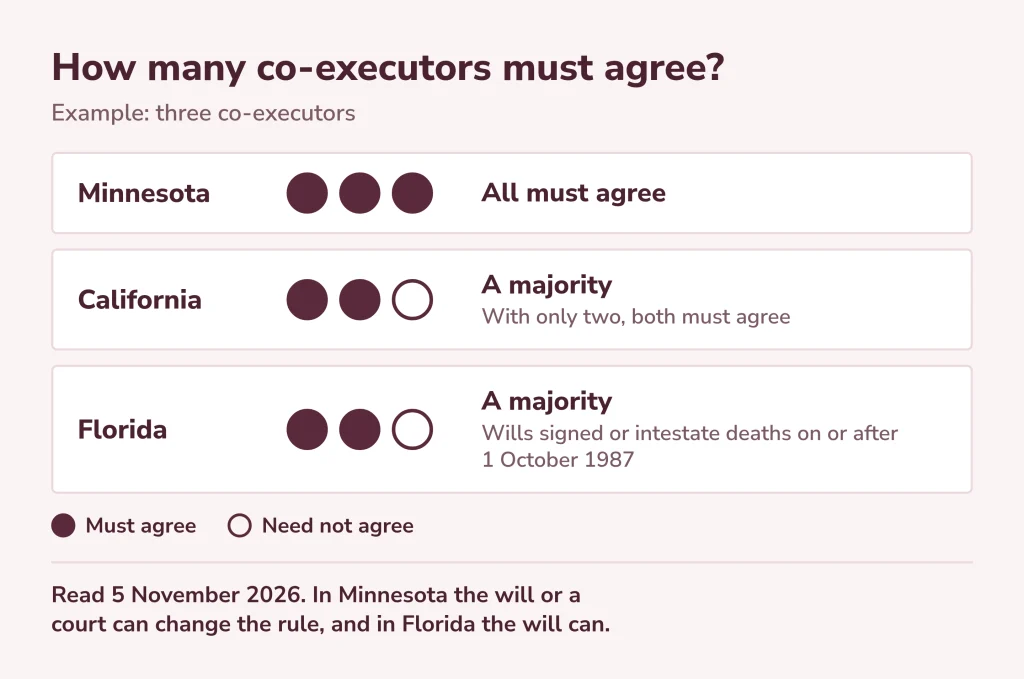
Two names on the will doesn’t mean two people each doing as they please. The rule depends on the state (read 5 November 2026). In Minnesota the will or a court can change it, and in Florida the will can:
- Minnesota: all must agree on acts of administration and distribution (524.3-717).
- California: two must both agree; with more than two, a majority (Prob. 9630).
- Florida: a majority, for wills signed or intestate deaths on or after 1 October 1987 (733.615).
Minnesota and Florida make room for emergencies needed to preserve the estate, for one executor receiving property due to the estate, and for one acting on the others’ delegation. In Florida, an executor who disagrees but joins at the majority’s direction isn’t liable for the action if they put the dissent in writing to the others at or before it.
Quit, or go to court without a lawyer
Saying no is easiest at the start. Illinois gives a named executor 30 days from learning of the nomination to start probate or refuse. Without good cause, a court can deny them the job (755 ILCS 5/6-3, read 5 November 2026 in the Illinois General Assembly’s public file repository). After appointment, leaving takes a process. A Minnesota resignation takes effect only once a successor is appointed and qualified and has received the assets (524.3-610). In Florida the court must find the estate won’t be harmed, and accepting the resignation doesn’t erase liability (733.502).
Some executors may not be able to handle probate without a lawyer at all. Florida Probate Rule 5.030 says every personal representative must be represented by a lawyer admitted in Florida, unless they remain the sole interested person. One who is a Florida lawyer may represent themselves. That’s the Florida Bar’s copy dated 15 October 2026, read 5 November 2026; a later amendment can’t be ruled out, so confirm with the clerk. Other courts set their own rules, so it’s worth asking the clerk before filing alone.
When an executor crosses the line
Even a will can’t excuse everything. In New York, a clause excusing an executor from liability for failing to use reasonable care is void as against public policy (EPTL 11-1.7). The usual consequences are:
- Paying it back. An executor is liable for loss caused by a breach of duty, as a trustee would be (Minnesota 524.3-712). California’s court may excuse an executor who acted reasonably and in good faith (Prob. 9601).
- Removal. Grounds differ by state, but they include wasting or mismanaging the estate, disobeying court orders, and certain conflicts of interest. See Florida 733.504, New York SCPA 711, and in Texas Est. Code 361.052 or, for independent executors, 404.0035.
- A bond. In Texas, an independent executor excused from bond can still be made to post one if shown to be mismanaging the property (404.002). A bond is a guarantee that pays the estate back for losses.
- Criminal charges. Texas Penal Code 32.45 names executors in its offense of misapplying fiduciary property, with penalties that rise with the amount.
Not every delay or disagreement is misconduct. Estates are slow, and an executor who says no to a beneficiary may be following the rules. The process usually starts with a written request for information, then the court that issued the letters. Certain moments call for a lawyer’s help: a deadline is running, money seems to be missing, the will is disputed, the estate may not cover its debts, a business is involved, or heirs are in open conflict.
Next step
If you’re the executor: before any deal that touches you personally, gather the will, your letters and the facts, and ask the court clerk or a lawyer which permission applies in your state. Keep a record of every payment. The executor’s job, in order shows what comes next.
If you’re a beneficiary or family member: write down what you’ve seen and when, and ask the executor in writing for what you want to know. The clerk of the probate court can tell you what’s on the public file and what process exists. If a deadline is running, that’s the point to talk to a lawyer.
Sources checked on 5 November 2026.
Sources
- California Probate Code 8400 (official text, read 5 Nov 2026)
- Minnesota Statutes 524.3-701 (read 5 Nov 2026)
- 2026 Florida Statutes 733.601 (read 5 Nov 2026)
- 2026 Florida Statutes 733.602 (read 5 Nov 2026)
- Minnesota Statutes 524.3-906 (read 5 Nov 2026)
- 2026 Florida Statutes 736.0803 (read 5 Nov 2026)
- Minnesota Statutes 524.3-912 (read 5 Nov 2026)
- Minnesota Statutes 524.3-203 (read 5 Nov 2026)
- IRS: Internal Revenue Manual 5.17.13, Insolvencies and Decedents' Estates (sections dated 9 Jul 2012)
- Kennedy v. Plan Administrator for DuPont Savings and Investment Plan, 555 U.S. 285 (2009) (Cornell LII)
- California Probate Code 9880 (official text, read 5 Nov 2026)
- California Probate Code 9881 (official text, read 5 Nov 2026)
- California Probate Code 9884 (official text, read 5 Nov 2026)
- California Probate Code 9885 (official text, read 5 Nov 2026)
- 2026 Florida Statutes 733.610 (read 5 Nov 2026)
- Minnesota Statutes 524.3-713 (read 5 Nov 2026)
- Texas Estates Code ch. 356, sections 356.651 to .654 (read 5 Nov 2026)
- Texas Estates Code 402.002 (read 5 Nov 2026)
- California Probate Code 10501 (official text, read 5 Nov 2026)
- New York EPTL 11-1.6 (read 5 Nov 2026)
- California Probate Code 9601 (official text, read 5 Nov 2026)
- Minnesota Statutes 524.3-715 (read 5 Nov 2026)
- California Probate Code 9730 (official text, read 5 Nov 2026)
- California Probate Code 10830 (official text, read 5 Nov 2026)
- New York SCPA 2310 (read 5 Nov 2026)
- New York SCPA 2311 (read 5 Nov 2026)
- Minnesota Statutes 524.3-721 (read 5 Nov 2026)
- 2026 Florida Statutes 733.6175 (read 5 Nov 2026)
- IRS Publication 559 (2025), Survivors, Executors, and Administrators
- CFPB: When a loved one dies and debt collectors come calling
- 31 USC 3713, Priority of Government claims (Cornell LII)
- Minnesota Statutes 524.3-807 (read 5 Nov 2026)
- Minnesota Statutes 524.3-909 (read 5 Nov 2026)
- Texas Estates Code 308.002 (read 5 Nov 2026)
- Texas Estates Code 404.001, 404.002, 404.0035 (read 5 Nov 2026)
- 2026 Florida Statutes 733.212 (read 5 Nov 2026)
- New York SCPA 2205 (read 5 Nov 2026)
- Minnesota Statutes 524.3-709 (read 5 Nov 2026)
- Minnesota Statutes 524.3-717 (read 5 Nov 2026)
- California Probate Code 9630 (official text, read 5 Nov 2026)
- 2026 Florida Statutes 733.615 (read 5 Nov 2026)
- Illinois 755 ILCS 5/6-3 (read 5 Nov 2026 in the Illinois General Assembly's public file repository)
- Minnesota Statutes 524.3-610 (read 5 Nov 2026)
- 2026 Florida Statutes 733.502 (read 5 Nov 2026)
- Florida Probate Rules, Rule 5.030 (Florida Bar copy dated 15 Oct 2026, read 5 Nov 2026)
- New York EPTL 11-1.7 (read 5 Nov 2026)
- Minnesota Statutes 524.3-712 (read 5 Nov 2026)
- 2026 Florida Statutes 733.504 (read 5 Nov 2026)
- New York SCPA 711 (read 5 Nov 2026)
- Texas Estates Code 361.052 (read 5 Nov 2026)
- Texas Penal Code 32.45 (read 5 Nov 2026)