There is no national deadline for an executor to pay beneficiaries. Several state laws we read tell executors to move promptly. Some add a date before which nobody can force payment, a date to report to the court, or a date when a cash gift starts earning interest. Debts, taxes and creditor claims come first, so payment usually comes near the end of the estate, not the start. This page is part of our guide to the executor’s job.
This page is general information, not legal or tax advice. Estate law varies by state and changes. Ask the court clerk, or a lawyer or tax professional, about your case.
For a sense of the wait, Oregon publishes real numbers. Of 11,796 estates closed in its courts in 2025, 63.3% closed within 360 days, 86.6% within 720 days, and 13.4% took longer. That is how old court files were at closing, in one state. It isn’t national, and it isn’t how long any one family waits. California’s courts say formal probate “typically takes 9 to 18 months” (both read 5 Nov 2026). Our page on how long probate takes covers the whole process.
The state rules we read
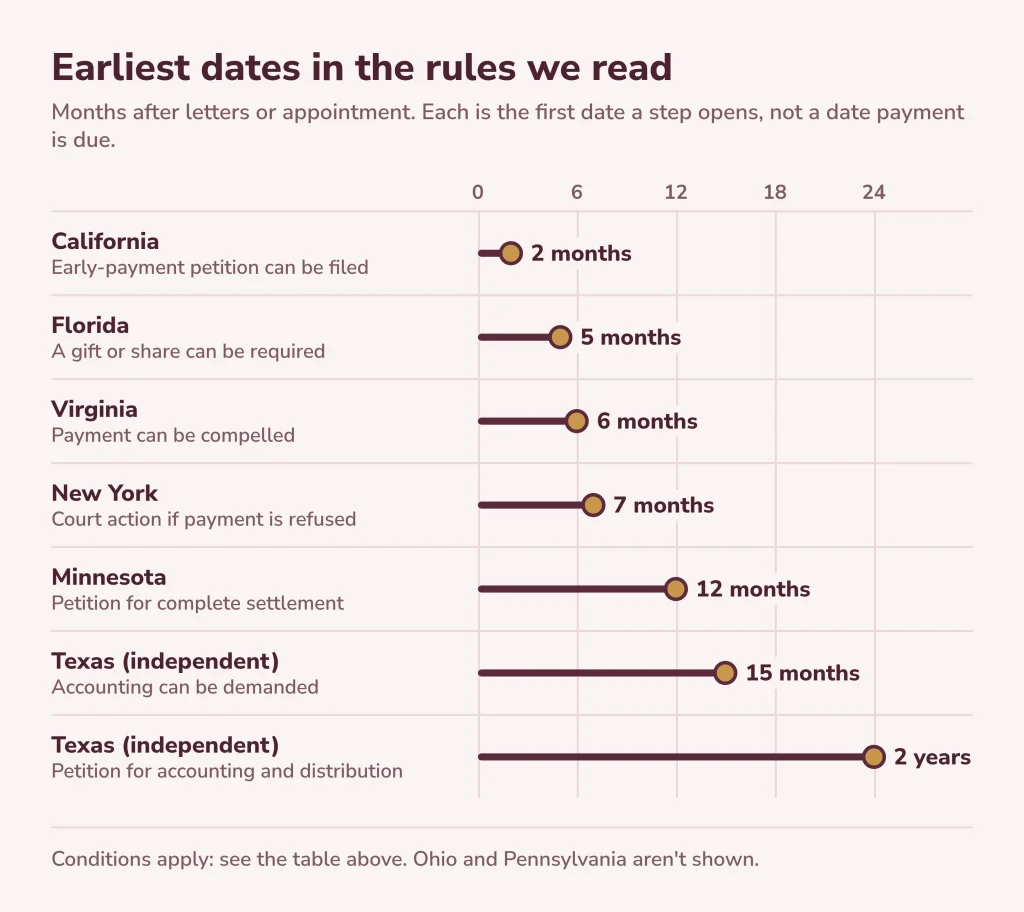
Most of the clocks in this table start when the court issues letters, the paper that gives the executor authority, not on the date of death. A death in March with letters in June means June is the date to count from.
The table isn’t a list of every state. It shows only statutes we read, with the date. If your state isn’t here, we haven’t confirmed its rule: ask the court clerk or a lawyer.
| State | What the law says about timing | Source, date read |
|---|---|---|
| California | A petition for early (preliminary) distribution can’t be filed until 2 months after letters. The executor must petition for final distribution or report on status within 1 year of letters, or 18 months if a federal estate tax return is required. | Prob. 11620, 12200, read 5 Nov 2026 |
| Florida | No one can require delivery of a gift or share until 5 months after letters. Before final distribution, a court also can’t make the executor pay a cash gift ahead of final settlement, deliver specific personal property (exempt property aside), pay a share of the personal estate or hand over land, unless the beneficiary shows the property isn’t needed for debts, taxes and similar costs. By court rule, the final accounting and petition for discharge are due within 12 months of letters, or 12 months from the return’s due date if a federal estate tax return is filed, unless the court extends the time. | Fla. Stat. 733.801, 733.802, Fla. Prob. R. 5.400(c) (15 Oct 2026 edition), all read 5 Nov 2026 |
| New York | The executor may pay sooner. Unless the will or a court directs otherwise, the executor needn’t pay before creditor notice has been published or, with no notice, before 7 months after letters. Once 7 months have passed since letters, a beneficiary refused on demand may bring a court proceeding, even if notice was published sooner. If notice was given that the person’s genetic material is available, the birth of a child conceived from it can move these dates later. | EPTL 11-1.5(a), (c), SCPA 2102(4), read 5 Nov 2026 |
| Ohio | The executor may distribute at any time after appointment if no action to set aside the will is pending. Administration is to be completed within 6 months of appointment unless extended. | ORC 2113.53, 2113.25, read 5 Nov 2026 in the official Ohio code |
| Pennsylvania | The executor may distribute early “at his own risk”. Protection from unknown claims is tied to one year after the first complete advertisement of letters. Claims against land have their own timing. | 20 Pa.C.S. 3532, read 5 Nov 2026 |
| Texas (independent administration) | Any interested person may demand an accounting once 15 months have passed since letters first issued. After 2 years, an interested person may petition for an accounting and distribution. | Est. Code 404.001, 405.001, read 5 Nov 2026 |
| Virginia | An executor can’t be compelled to pay until 6 months after the order appointing the first executor. Unless the will says otherwise, the beneficiary must also give a refunding bond, a promise to pay back a share of later claims. | Va. Code 64.2-554, read 5 Nov 2026 |
| Minnesota | An interested person may petition for complete settlement one year after the first executor’s appointment. It can’t be heard until the claims period has ended. | Minn. Stat. 524.3-1001, read 5 Nov 2026 |
Behind dates like these, several states set a general standard. Florida and Minnesota both say “as expeditiously and efficiently as is consistent with the best interests of the estate”. Arizona says “expeditiously”. Washington says “as rapidly and as quickly as possible, without sacrifice to the probate or nonprobate estate”. None of these gives a number of days (all read 5 Nov 2026).
You may read that an executor must pay within a year. We found no such national rule. California’s one-year date, above, can be met with a status report, not a payment. Ohio’s six months can be extended. These are reporting and closing dates.
Why beneficiaries wait
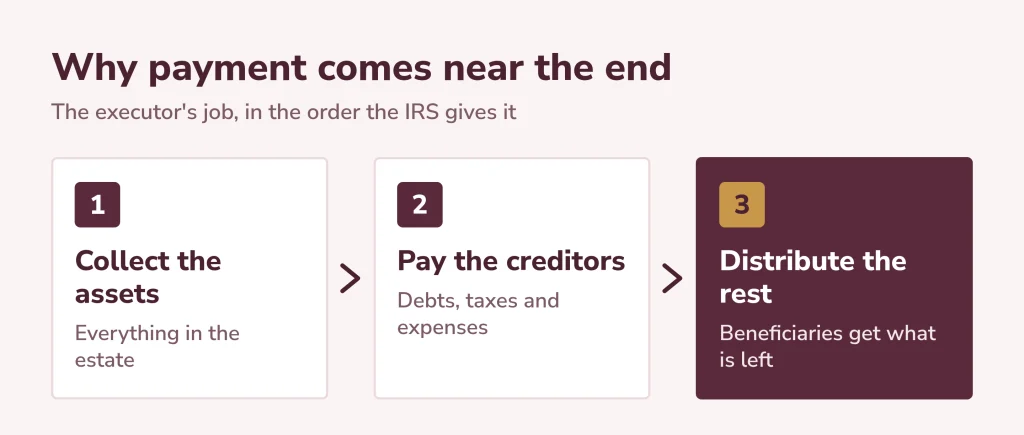
The IRS sums up the job in one line: “collect all the decedent’s assets, pay the decedent’s creditors, and distribute the remaining assets”. That order is why the wait exists. What a beneficiary gets depends on what is left after the first two steps.
Creditors get a window
The states below give creditors a set period to come forward. An executor who pays out before it closes can be left short. The windows we read:
- California: the later of 4 months after letters or 60 days after notice is given to the creditor (Prob. 9100, read 5 Nov 2026).
- Florida: the later of 3 months after notice is first published or 30 days after service on the creditor (733.702). Claims are generally cut off 2 years after death (733.710, both read 5 Nov 2026).
- New York: 7 months from letters. This isn’t a hard bar. It protects an executor who paid in good faith before a late claim arrived (SCPA 1802, read 5 Nov 2026).
- Ohio: generally 6 months after death (ORC 2117.06, read 5 Nov 2026 in the official Ohio code).
Taxes come next
The final income tax return, any estate income tax return and any estate tax return all have to be dealt with. For deaths in 2026, a federal estate tax return is mainly a concern for large estates, with a $15,000,000 basic exclusion and a 9-month due date. An estate that files one can take longer, and California allows 18 months where one is required. New York’s rule makes the point in plain terms: an executor has a “duty to retain sufficient assets” for expenses, debts and taxes before paying gifts.
The executor carries real risk
Executors generally don’t owe an estate’s debts from their own money. The CFPB says, of a spouse’s estate, that debt collectors can’t say or hint that an executor must pay from their own money. There is an exception. Under 31 USC 3713(b), a representative “paying any part of a debt of the person or estate before paying a claim of the Government is liable to the extent of the payment”. The IRS manual ties this to an estate that can’t pay all its debts and an executor who “has knowledge of the federal tax debt”, and limits it to the value of what was paid out ahead of the claim. So an executor who is slow may be careful, not careless.
Two IRS forms can narrow that risk, though both take time. Form 4810 asks the IRS to assess tax within 18 months of the request, for returns other than the estate tax return. Form 5495 asks for discharge from personal liability, and the same IRS publication gives the IRS 9 months to reply with any amount due. An executor waiting on either may hold money back until the answer comes.
Other things that hold up payment
- A will dispute. Ohio’s permission to distribute early, for one, applies only with no action pending to set the will aside. See how a will contest works.
- Things that must be sold. A house, a business or a share of land may have to be sold or transferred before anyone can divide its value.
- Missing people or papers. An heir who can’t be found, or an account nobody knew about.
- A court’s own conditions. A Multnomah County, Oregon, court page says partial distributions won’t be approved until 4 months from first publication, with notices and a creditor search done first (read 5 Nov 2026).
Some money doesn’t wait for the executor
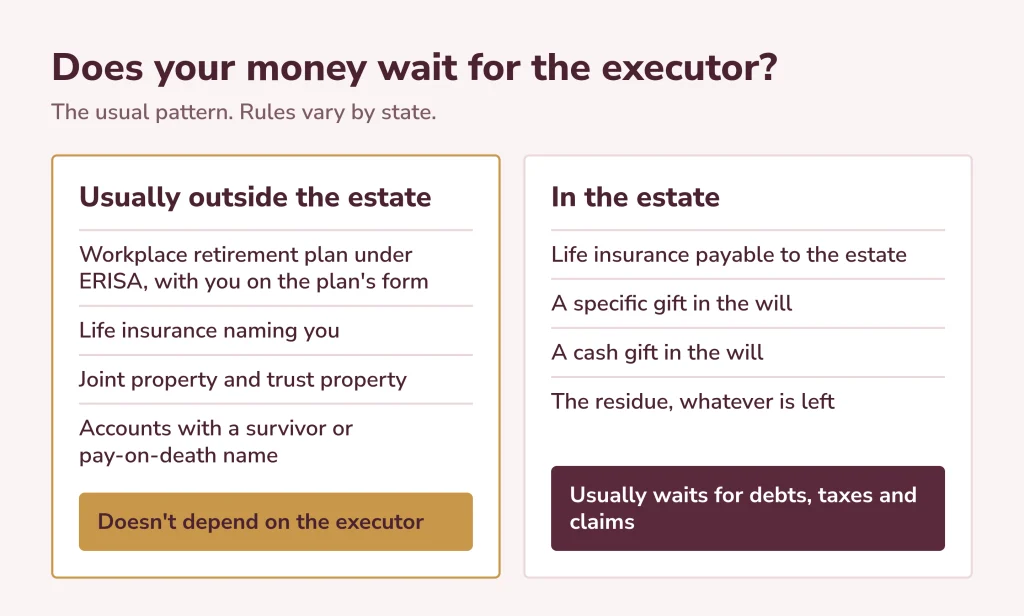
If you are named on an account or policy, your money may not be in the estate at all. It then doesn’t depend on the executor, and you can ask the company holding it directly.
- Workplace retirement plans under ERISA, the federal pension law, generally pay the person named on the plan’s own form (Kennedy v. DuPont, 2009).
- Life insurance with a named person usually goes to that person. If it’s payable to the estate, it joins the estate. Florida’s 222.13 (read 5 Nov 2026) shows both sides. Other states have their own rules.
- Joint property, trust property and accounts with a survivor or pay-on-death name generally pass outside the estate. California’s Prob. 13050 lists these for its small estate test (read 5 Nov 2026), and the IRS manual treats jointly held property the same way for tax debts.
Very small estates may skip full probate, so there may be no executor and no court clock. Each state has its own route and limit.
The order gifts usually get paid
Wills tend to make three kinds of gift. They often move at different speeds.
- A specific gift: the ring, the car, the house. It can often be handed over earlier, once it’s clearly not needed for debts.
- A cash gift: “$10,000 to my niece”. Lawyers call this a general or pecuniary gift. It is paid from the estate’s cash, so it waits until the cash is known to be enough.
- The residue: whatever is left. It usually comes last, because the amount can’t be worked out until debts, taxes and expenses are final. If those take everything, it can be small or nothing.
If you have heard “the others got paid and I didn’t”, this can be why. An executor who pays some people before others for a personal reason is a different matter. Our page on what an executor can’t do covers conflicts of interest and self-dealing.
Early and partial payments
Several of the rules above let an executor pay part of a gift before the end. The cost is risk, so courts and statutes attach conditions (sections read 5 Nov 2026):
- California: the court orders early distribution if it can be done without loss to creditors or injury to the estate. It must require a bond if it orders distribution within 4 months of letters, and may require one after that (Prob. 11622). An executor with independent authority who asks under Prob. 11623 is capped at 50% of the estate’s net value.
- Florida: a court can require a bond from someone taking a partial distribution.
- New York: a beneficiary who needs money for their own or their family’s support or education can ask the court for an advance if the estate holds at least a third more than known claims, priority gifts and gifts of the same class (SCPA 2102(5)).
- Virginia: a court process can protect an executor who distributes under its order, but recipients can be made to refund their share of allowed claims for up to 5 years (64.2-556).
- Ohio: a beneficiary paid early can be personally liable to a creditor with a valid, timely claim, and must return assets if a spouse elects against the will or the will is set aside (2113.53).
Early money can come back. And if estate income is distributed without its tax being paid, the IRS says a beneficiary “can be liable for tax due and unpaid to the extent of the value of the estate assets received”.
Interest on a late gift
Delay can cost the estate, but only for some gifts in some states. In all of these, the will can change the gift rule.
| State | Rule | Source, date read |
|---|---|---|
| California | A cash gift not paid within 1 year after death bears interest from then. The rate is 3 points below the legal rate on judgments in effect at that date. A specific gift bears no interest but carries its income from the date of death, less expenses. | Prob. 12003, 12001, 12002, 12000, read 5 Nov 2026 |
| Pennsylvania | A cash gift not in trust earns income at 5% a year from 1 year after death until paid; one in trust, from the date of death. A specific gift gets its net income from the date of death. Separately, a court may charge an executor who breached a duty interest of up to the legal rate. | 20 Pa.C.S. 3543, 3544, read 5 Nov 2026 |
| Minnesota | A cash gift bears interest at the legal rate from 1 year after the first executor’s appointment. | Minn. Stat. 524.3-904, read 5 Nov 2026 |
| Arizona | Same rule as Minnesota. | A.R.S. 14-3904, read 5 Nov 2026 |
| Ohio | General gifts bear no interest unless the will says so. | ORC 2113.531, read 5 Nov 2026 in the official Ohio code |
The New York section in the first table sets no interest rate in the text we read, and we didn’t check other New York rules on this. Not confirmed for New York: if interest matters in your case, ask the court or a lawyer.
If you think the delay has gone too far
A long wait isn’t proof of a problem. Silence is harder to read. These steps go roughly from least to most formal. The statutes named were read on 5 Nov 2026.
- Ask in writing. Ask what is finished, what is holding things up, and when the executor expects to pay. A short, dated note is easier to look back on than a phone call.
- Ask the court what is on file, such as whether letters were issued and what has been filed. Court staff generally can’t give legal advice, as the Multnomah page says of its own staff.
- Ask for an accounting, a record of what came in and went out. In Texas, any interested person can demand one after 15 months, and can go to court if it hasn’t come within 60 days. In New York, a court can order an account at any time if it serves the estate, on a petition from an interested person. A separate proceeding can require information an executor failed to give after a written request.
- Ask the court to step in. A California court can call the executor in to explain why the estate can’t be closed. It can also reduce the executor’s pay for time beyond what is allowed, if the delay was within their control and not in the interest of the estate or those with a stake in it. In New York, an executor who misses a court’s account deadline may be suspended. Florida’s removal grounds include failing to comply with a court order or wasting estate assets, and Texas’s include failing to make a required accounting.

This is the point at which to get a lawyer: a deadline is running, you suspect money is missing or fraud, the will is disputed, the estate may not be able to pay its debts, a business is involved, or heirs are in open conflict. We can’t say whether a given delay is reasonable. A court decides that.
If you are the executor
People who are waiting tend to assume the worst when they hear nothing, and that can turn a normal delay into a dispute. Some questions to take to the clerk, a lawyer or a tax professional:
- When did the claims period start, and when does it end in this state?
- Which tax returns are still due, and has any been filed that could still be questioned?
- Is there any sign of an unpaid federal tax debt?
- Does this state need a court order before payment, or just receipts?
- How much should stay back for final bills and taxes?
- Can partial payments be made safely, and on what terms?
Receipts matter. California has executors file receipts for all property by the time they ask for discharge, though a court can excuse one that can’t be obtained, and Pennsylvania lets executors file receipts, releases and refunding agreements after an early distribution. A release gives up more than a receipt does, so beneficiaries often want to know exactly what it covers before signing. In Texas, an independent executor can ask for a signed receipt but can’t require a waiver or release as a condition of delivery, and may keep a reasonable reserve when asking the court for discharge, so a last small payment can follow. Executor pay comes out of the estate. Minnesota, for one, puts costs of administration first when an estate can’t pay every claim (all statutes in this paragraph read 5 Nov 2026). Our executor fee calculator shows what the state schedules work out to.

Tax on what you receive
An inheritance itself isn’t included in your income for federal tax, says the IRS. Some money is treated differently. Income the person was due but hadn’t received at death, such as the taxable part of an inherited traditional IRA, is “income in respect of a decedent”, taxed to the estate or the beneficiary who receives it. Income the estate earns while it’s open is also taxable. The executor gives each beneficiary a Schedule K-1. If the estate must distribute all its income currently, the IRS says “you must report your share of the distributable net income, whether or not you have actually received the distribution.” So a beneficiary can see a K-1 before seeing a check. Our guide to Form 1041 explains the estate’s return.
Your next step
If you are a beneficiary, start with the date letters were issued. The court file in the county where the estate was opened should show it. Then look for your state’s rule, and send the executor a short written question about what is left to do. The rest can wait for the answer, unless a deadline is running.
If you are the executor, write down the date of your letters, the end of the claims period and every tax return still due. Those are what your answer to the family rests on. Anything else can wait for a lawyer or tax professional.
Sources checked on 5 November 2026.
Sources
- California Probate Code 9100, 11620, 11621, 11622, 11623, 12000-12003, 12200, 12202, 12205, 11753, 13050 (read 5 Nov 2026 on leginfo)
- Florida Statutes 733.801, 733.802 (2026)
- Florida Statutes 733.602, 733.702, 733.710, 733.504, 222.13 (2026)
- Florida Probate Rules, Rule 5.400(c), 15 October 2026 edition, The Florida Bar
- New York EPTL 11-1.5
- New York SCPA 1802, 2102, 2205
- Pennsylvania 20 Pa.C.S. ch. 35 (3532, 3543, 3544), official PDF
- Texas Estates Code ch. 404
- Texas Estates Code ch. 405
- Virginia Code 64.2-554
- Virginia Code 64.2-556
- Minnesota Statutes 524.3-703, 524.3-805, 524.3-904, 524.3-1001
- Arizona Revised Statutes 14-3704, 14-3904
- Washington RCW 11.48.010
- Ohio Revised Code 2113.25, 2113.53, 2113.531 and 2117.06 (read 5 Nov 2026 in the official Ohio code)
- Oregon State Trial Courts, age of terminated cases 2025
- Multnomah County Circuit Court probate FAQ
- California Courts self-help: formal probate
- IRS Publication 559 (2025), Survivors, Executors, and Administrators
- IRS Instructions for Form 706 (Rev. July 2026)
- Internal Revenue Manual 5.17.13
- 31 USC 3713
- CFPB: Am I responsible for my spouse's debts after they die?
- Kennedy v. Plan Administrator for DuPont Savings and Investment Plan (2009)