In Texas, a small estate affidavit lets the heirs collect a relative’s property without a court-appointed administrator. It works only if the person died without a will, 30 days have passed, and the estate is worth $75,000 or less, not counting a qualifying homestead and exempt property. It isn’t a private form you hand to a bank: a judge has to approve it first. The limit is in Texas Estates Code 205.001(3), read on 5 November 2026. It has applied since 1 September 2017 to small estate cases started on or after that date, whatever the date of death.
This page is general information, not legal or tax advice. Estate law varies by state and changes. Ask the court clerk, or a lawyer or tax professional, about your case.
This page is part of our guide to small estates and skipping probate, and small estate affidavits by state covers the rest of the country. In Texas, the house is where many families get tripped up. In this law, “homestead” covers only a home that could be set aside for a surviving spouse or minor children, so the affidavit can’t pass a parent’s home to grown children.
The Texas rules at a glance
All of this comes from Chapter 205 of the Estates Code, read on the Texas Legislature’s site on 5 November 2026. The statute calls the heirs who receive the property “distributees”.
| Rule | What the statute says | Section |
|---|---|---|
| Will | Only for someone who died without a will. The chapter doesn’t affect property passing under a will. | 205.001, 205.008(a) |
| Waiting period | 30 days must have passed since the death. | 205.001(1) |
| No other case | No petition to appoint a personal representative (an executor or administrator) is pending or has been granted. | 205.001(2) |
| Value limit | $75,000 or less on the date of the affidavit, not at death, leaving out homestead and exempt property. | 205.001(3) |
| Assets over debts | The same assets must exceed known debts. Debts secured by homestead or exempt property aren’t counted. | 205.001 |
| Signatures | Sworn by two disinterested witnesses and each heir with legal capacity. Where the facts call for it, a natural guardian or next of kin signs for a minor heir, and a guardian for an incapacitated heir. | 205.002(a)(1) |
| Judge | Filed with the clerk of the court with jurisdiction and venue. The judge examines it and “may approve” it. | 205.001(4)-(5), 205.003 |
| After approval | Heirs give a copy certified by the clerk to anyone who owes the estate money or holds its property. | 205.004 |
| Land | No real property passes, except a homestead that is the only real property in the estate. | 205.006, 205.008(b) |
The $75,000 figure replaced $50,000 under H.B. 2271, effective 1 September 2017. The section’s history shows no later change. “May approve” matters too: Bexar County Probate Court No. 2 says granting one is in the court’s discretion, and the Harris County Law Library warns that a court doesn’t have to accept an affidavit even if it meets every requirement.
The house: spouse or minor children only
You’ll often read that the homestead is simply left out of the $75,000. That is true only for some families. Section 205.009 limits the word to “a homestead or other exempt property that would be eligible to be set aside under Section 353.051”. And Section 353.051(a)(1) sets the homestead aside “for the use and benefit of the decedent’s surviving spouse and minor children.” Grown children aren’t on that list.
Courts’ own instructions say the same. Harris County’s form (revised 15 April 2025) says the homestead “only passes to a surviving spouse or minor children”. Tarrant County’s 2026 packet says homestead is what the surviving spouse or minor child retains, “ONLY”. TexasLawHelp says the home must go only to a surviving spouse or minor children who were living there.
Here is what that means in practice:
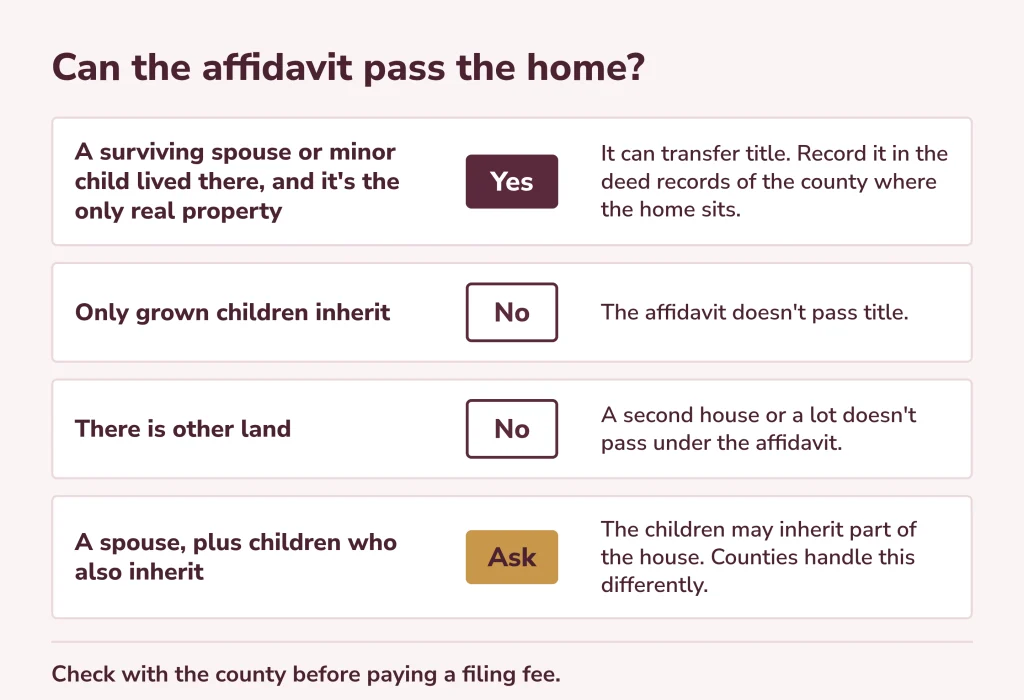
- A surviving spouse or minor child lived there, and it’s the only real property. The affidavit can transfer title, and it must be recorded in the deed records of the county where the home sits (205.006(a)). Harris County asks for the street address and legal description.
- Only grown children inherit. The affidavit doesn’t pass title. On the statute’s wording, a house like this also isn’t a “homestead” that gets left out of the count, so ask the clerk how your court treats it.
- There is other land. A second house or a lot doesn’t pass under the affidavit (205.008(b)), and the home itself passes only if it is the only real property in the estate (205.006(a)). The court will look: Bexar and Ector counties say the court always checks the real property records.
- A spouse, plus children who also inherit. If any child of the decedent isn’t also the surviving spouse’s child, the decedent’s half of community property goes to the decedent’s children (201.003(c)). Community property is broadly what a couple acquired during the marriage other than by gift or inheritance, which can include the house. If the house was the decedent’s separate property, the spouse gets a life estate in one-third, meaning the use of it for life, and the children take the rest (201.002(b)). See the county test below.
Counties handle real property differently, so check before paying a filing fee. Bexar County Probate Court No. 2 (checklist updated January 2019) and Ector County’s checklist (undated) say an affidavit can’t be approved if the person owned real property, unless it was the homestead and everyone inheriting any interest was homesteading there at the death. Harris County’s flowchart lets heirs go on to other assets if the non-exempt ones are within $75,000, and tells them to contact an attorney about any real property.
What counts toward the $75,000
Harris County’s form lists the usual assets: bank accounts, cash, vehicles, stocks and real estate. Three rules shape the total.
- Value on the affidavit date. The statute measures value on the date of the affidavit, and the Tarrant form and the Bexar and Ector checklists agree. But one line of Tarrant’s instruction sheet asks for value at the date of death, and Harris’s form asks for a stock’s value at death, so ask if the two figures differ much. An asset of “unknown value” can’t be approved, say Harris and Ector.
- The person’s own share. For a married person, Ector County wants each asset marked separate or community, with the value of the decedent’s interest in the value column.
- Only estate assets. Money in a joint account with a signed survivorship agreement belongs to the survivor (113.151), and a payable-on-death account goes to the named payee (113.152). Insurance and retirement plans paying a named person pass by contract (111.052). If an account has no signed agreement, ask the bank what its records show.
Exempt property needs a qualifying relative
Exempt property is left out too, but again only if someone qualifies. Under 353.051(a)(2), it is set aside for a surviving spouse and minor children, unmarried adult children still living with the family, and any other adult child who is incapacitated. If none of those relatives survive, nothing is exempt for this purpose, and the car and furniture count.
The list is in Property Code 42.002(a). It includes home furnishings and heirlooms, food, clothing, two firearms, sporting equipment, pets, tools of a trade, some livestock, jewelry up to a limit, and a vehicle for each family member or single adult who holds a driver’s license or relies on someone else to drive. Section 42.001(a), read on 5 November 2026, caps the total at $100,000 for a family and $50,000 for a single adult. The Bexar and Ector checklists also name the person’s pension benefits, IRAs and insurance benefits as exempt. The affidavit must say which assets are claimed as exempt (205.002(b)).
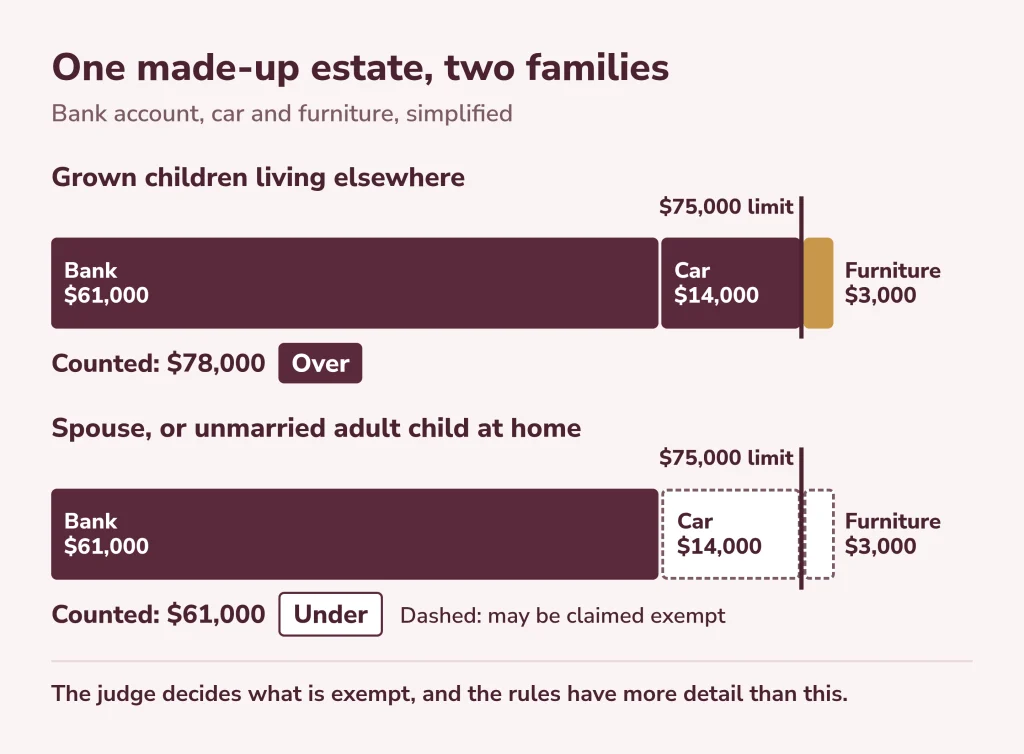
Here is one made-up estate, simplified, with two different families:
| Asset | Grown children living elsewhere | Spouse, or unmarried adult child at home |
|---|---|---|
| Bank account | $61,000 counts | $61,000 counts |
| Car | $14,000 counts | $14,000 may be claimed exempt |
| Furniture | $3,000 counts | $3,000 may be claimed exempt |
| Counted toward the limit | $78,000: over | $61,000: under |
The judge decides what is exempt, and the rules have more detail than this. Ector County calls it “not the easiest concept”.
Debts
The form must list everything owed: cards, medical bills, utilities and anything else unpaid. Tarrant County also wants funeral bills and lawyer’s fees listed if the estate will pay them. Don’t leave the box blank: if there are no debts, write “none”. A debt secured by exempt property, such as a loan on an exempt car, stays out of the comparison. If debts are higher than assets, Ector County says the affidavit must be denied, but heirs can pay down debts until assets exceed what remains. For how debts work after a death, see what happens to debts when someone dies.
Who has to sign
Every heir. Bexar County says an affidavit can’t be approved if an heir can’t be found or refuses to sign. If an heir has died since, and no representative was appointed for that heir, Ector County sends you to a heirship application instead. Who the heirs are, and their shares, comes from Chapter 201, and it’s a common reason for rejection: Bexar lists wrong shares among its usual mistakes. Our page on dying without a will explains the idea. Some county packets, such as Ector’s, include the Texas charts.
Two disinterested witnesses. Harris County says they must not have or be entitled to any share of the assets, and its form asks how long they knew the person. Tarrant County wants personal knowledge of the family history. Ector County goes further: they must be able to swear to all the facts in the affidavit. All signers appear before a notary. Witnesses carry the same liability as heirs, described below, so it helps if they know that before signing.
Minor or incapacitated heirs. The statute lets a natural guardian or next of kin sign for a minor where the facts warrant. Counties part ways here:
- Tarrant County says the affidavit can’t be used if any heir is under 18 or incapacitated.
- Ector County won’t approve one unless what the minor inherits can be held in the court’s registry, an account the court controls, until age 18.
- Harris County lets a natural parent, guardian or managing conservator sign.
How to file, step by step
- Wait at least 30 days. Bexar County advises waiting long enough to be sure you have all the bills.
- Find the right county. Normally it’s where the person lived, as with other probate filings (33.001). Bexar and Ector say approval elsewhere is unusual.
- Get that court’s form. There is no single form every court takes. Bexar’s 2019 checklist requires its own, and Harris recommends its own. TexasLawHelp’s checklist has a general form and warns that some courts require theirs, and its article links county forms.
- List everything in detail. Bexar and Ector ask for VINs for cars, the last four digits of accounts and the creditor for each debt, while Harris’s form asks for the account number. Leave no blanks.
- Answer the Medicaid question. See the section below.
- Sign before a notary. All heirs and both witnesses.
- File with the clerk. Bexar and Ector want a copy of the death certificate, and Bexar wants the Social Security number crossed out. TexasLawHelp’s checklist adds a proposed order. Pay the fee, or file the fee waiver below.
- Wait for the judge. Chapter 205 sets no time. Harris and Ector say a hearing usually isn’t needed, and the court will contact you if one is. TexasLawHelp notes the case isn’t final until the signed order is filed.
- Order certified copies of the approved affidavit and order, and give one to each bank, company or person holding estate property (205.004).
- Record it in the county deed records if it transfers a homestead.
What it costs
Texas has no one filing fee. Counties charge different amounts, and these are the two we could read in county papers on 5 November 2026:
| County | Filing fee | Copies | Source |
|---|---|---|---|
| Harris | $360 | Certified, from the office: $5 per document plus $1 a page. Certified, electronic: the form says $5 per document plus $0.10 a page; the clerk’s page says $5 plus $1 for up to 10 pages and $0.10 for each page after that, so ask which applies | Form I-02-22, rev. 15 Apr 2025; clerk’s probate page |
| Tarrant | $404 | Fee includes one certified copy and a posted citation | 2026 packet, letter dated 10 Feb 2026 |
- Filing online can cost more. Harris County’s clerk (undated page) lists a $30 state fee per new case and a $2 county fee per envelope, plus any charges from a filing provider. Someone without a lawyer may e-file there but doesn’t have to. Ask your clerk.
- Bexar County warns that applicants lose their filing fees when an affidavit is denied for a problem that can’t be fixed.
- Bexar and Ector say heirs may fill out an affidavit without a lawyer, and that a lawyer’s advice may prevent wasted time and money. If a lawyer is paid, the Tarrant form asks for the amount.
- If paying is a problem, ask the clerk about a fee waiver. Harris County’s clerk lists a Statement of Inability to Afford Payment of Court Costs among its probate forms, and TexasLawHelp’s checklist, a legal aid guide, says to file it with the affidavit. We couldn’t open the court rule behind it.
After approval: banks, cars and refusals
A certified copy gives the holder of an asset legal cover. Anyone paying or transferring under the affidavit is released as if they had dealt with a personal representative, and doesn’t have to look into whether its statements are true (205.007(a)). If someone refuses, the heirs can sue to recover the property (205.007(d)).
Refusals still happen. The Harris County Law Library says some banks, especially outside Texas, may ask for letters of administration or letters testamentary instead: the court papers that name someone to act for an estate. Harris County’s form adds that you can’t open an estate account with the affidavit, and that a company must reissue any check, so ask first whether it will accept the affidavit. If there was a safe deposit box, that form points to a separate application to open it.
Cars. TxDMV’s title manual (August 2026) says a certified copy of the approved affidavit must go with the title transaction, and the title goes to the heir named or to someone that heir assigns it to. If a car is all that needs moving, there’s a route with no court: Form VTR-262, the Affidavit of Heirship for a Motor Vehicle, for estates with no administration and none needed. Heirs sign before a notary, with no power of attorney allowed, and the form warns that false statements are a third-degree felony. The manual says a death certificate isn’t required with it.
Check Medicaid before you file
Court forms ask whether the person applied for and received Medicaid on or after 1 March 2005. Tarrant County’s form says recovery claims “are debts of the estate”, and that a certification must be attached if the answer is yes. Ector County gives three ways through if the answer is yes: list the amount as a debt, file a certification from the Medicaid Estate Recovery Program (MERP) that no claim applies, or show that no claim will be filed.
Texas Health and Human Services (read 5 November 2026) says the program covers long-term care services received after age 55, where those services began after 1 March 2005. It won’t seek money in several cases, including:
- A spouse is still alive.
- There is a child under 21, or a child of any age who is blind or permanently and totally disabled under Social Security rules.
- An unmarried adult child lived full-time in the home for at least a year before the death.
- The estate is worth $15,000 or less, or Medicaid costs are $5,000 or less.
Heirs can also ask for a hardship waiver. HHS says Stellarware Corporation took over MERP operations on 1 September 2026, but the certification form we read (revised September 2023) still names the old contractor. Call 800-641-9356, the number on both, and ask where to send it. Our page on whether Medicaid can take the house has the wider picture.
The risks that stay after approval
- Heirs can be made to answer. They’re answerable to anyone with a prior right, and accountable to any personal representative appointed later (205.007(b)).
- Signers carry liability. Each person who signed is liable for damage or loss arising from a payment or transfer made in reliance on the affidavit (205.007(c)). That includes the witnesses, as Ector County points out.
- Heirs left out. A buyer in good faith with no notice of an undisclosed heir takes the homestead free of that heir’s interest, but the heir can recover from the heir who was paid (205.006(b)-(c)).
- Creditors. That same buyer stays subject to creditors’ legal claims. Where a spouse or minor child survives, the homestead is protected from most estate debts, but not from items such as a mortgage or taxes on the home (102.004).
This is the point to get a lawyer: an heir who disputes the facts or can’t be found, a will that turns up, suspected fraud, debts that may be more than the assets, a business, or real property outside the simple cases above.
If the affidavit doesn’t fit
| Situation | What to ask about | Source |
|---|---|---|
| There is a will, and no unpaid debts apart from real estate liens, or no need for administration | Probate as a muniment of title, where the court admits the will without appointing anyone | 257.001 |
| No will, and a house going to grown children | A court determination of heirship. An affidavit of heirship is the informal option: a sworn family history recorded in the deed records, which is evidence and not a court ruling | Ch. 202, Ch. 203; State Law Library |
| Apart from homestead and exempt property, assets are no more than the family allowance for a spouse, minor children or incapacitated adult children | An order of no administration | 451.001 |
| Someone needs authority to sell, sue or deal with creditors | Full administration, or probate with letters | 205.001(2) bars the affidavit once a petition is pending. Bexar and Ector won’t approve one if administration appears needed |
Ector County notes that someone applying to determine heirship must be represented by an attorney.
Your next step
Gather three things: a death certificate, a list of what the person owned with current values, and a list of what they owed. Look for a will first: Tarrant County says the affidavit can’t be used if there is one, whether or not it was offered for probate. Then call the probate clerk in the county where the person lived and ask:
- Which form does this court require, and what is the filing fee today?
- If the person owned a home, and no spouse or minor child survives, can this court approve an affidavit at all?
- Does the court take an affidavit with a minor heir?
Tarrant County warns that its staff can’t give advice or answer questions on using this form, so a clerk may not answer all of these. If so, go by the court’s written instructions. Selling or dividing anything can wait until you know which route applies. Chapter 205 sets no deadline to file, but value is measured on the affidavit date, so a list drawn up now may need updating before anyone signs.
Sources checked on 5 November 2026. We read the Estates Code and Property Code on the Texas Legislature’s site. County rules here come from the Harris, Tarrant, Bexar and Ector papers only. We couldn’t open Bexar County’s current form, and we didn’t read other counties’ rules or fees, so ask your clerk.
Sources
- Texas Estates Code ch. 205, Small Estate Affidavit (read 5 Nov 2026)
- Texas H.B. 2271 (2017), enrolled: sections 12, 46 and 52
- Texas Estates Code ch. 353, Exempt Property and Family Allowance
- Texas Estates Code ch. 201, Descent and Distribution
- Texas Estates Code ch. 102, Decedent's Homestead
- Texas Estates Code ch. 33, Venue
- Texas Estates Code ch. 111, Nonprobate Assets
- Texas Estates Code ch. 113, Multiple-Party Accounts
- Texas Estates Code ch. 202, Determination of Heirship
- Texas Estates Code ch. 203, Nonjudicial Evidence of Heirship
- Texas Estates Code ch. 257, Probate of Will as Muniment of Title
- Texas Estates Code ch. 451, Order of No Administration
- Texas Property Code ch. 42, Personal Property
- Harris County Probate Courts: Small Estate Affidavit form and instructions, I-02-22 (rev. 15 Apr 2025)
- Harris County Clerk: Probate Courts page, fee list, e-filing FAQ and forms (undated)
- Harris County Law Library: Small Estate Affidavits (Feb 2023, modified Aug 2024)
- Tarrant County Probate Courts: Small Estate Affidavit packet (letter dated 10 Feb 2026)
- Bexar County Probate Court No. 2: Small Estate Affidavits and checklist (updated 18 Jan 2019)
- Ector County: Small Estate Affidavit checklist (undated, county-hosted page)
- TexasLawHelp: Small Estate Affidavits (legal review 31 Oct 2025, edited 28 Aug 2026)
- TexasLawHelp: Instructions and forms for a Small Estate Affidavit (legal review 26 Jan 2023)
- Texas State Law Library: Probate Law, Informal Methods (updated 23 Oct 2026)
- Texas HHS: Your Guide to the Medicaid Estate Recovery Program
- Texas HHS: MERP Authorization and Certification form (rev. 09-2023)
- TxDMV: Motor Vehicle Title Manual (August 2026)
- TxDMV: Form VTR-262, Affidavit of Heirship for a Motor Vehicle (rev. 11/20)