
A full probate often takes about 9 to 18 months. That is the range California’s court self-help page gives for formal probate, adding that it can take longer (page undated, read 5 November 2026). It fits the best hard numbers we found: of the 11,796 estate cases Oregon’s courts closed in 2025, 63.3% closed within 360 days and 78.5% within 540 days. But 13.4%, about one in seven, ran past 720 days, which is about two years.
A small estate can take weeks instead, and some property never goes through probate at all. No national time limit exists, and we found no national figure, so the California range is a guide, not a rule. Time depends on your state, your county court and what’s in the estate. Below is what the clock is made of, stage by stage. For the rest of the process, see Probate Step by Step.
This page is general information, not legal or tax advice. Estate law varies by state and changes. Ask the court clerk, or a lawyer or tax professional, about your case.
What the court data shows
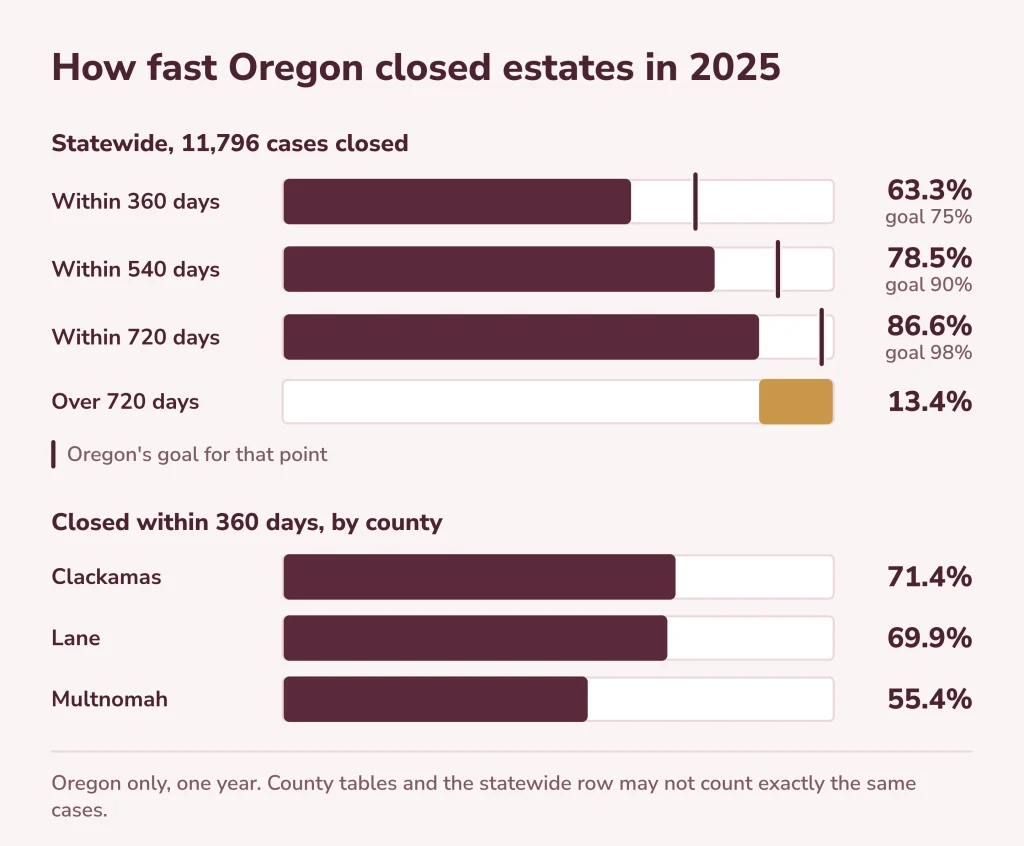
Oregon publishes how old its court cases were when they ended. It’s the only statewide table of closed estates by age that we found. These are the 2025 figures, read 5 November 2026, with the share closed by each point adding up as you read across.
| Court | Within 360 days | Within 540 days | Within 720 days | Over 720 days | Cases closed |
|---|---|---|---|---|---|
| Oregon, statewide | 63.3% | 78.5% | 86.6% | 13.4% | 11,796 |
| Clackamas County | 71.4% | 85.5% | 93.0% | 7.0% | 1,131 |
| Lane County | 69.9% | 83.3% | 90.1% | 9.9% | 1,051 |
| Multnomah County | 55.4% | 71.1% | 81.9% | 18.1% | 1,863 |
Three things stand out:
- More than a third took longer than 360 days, just under a year. In the statewide row, 36.7% of cases were still open at 360 days.
- The county matters. Oregon’s law is the same in Clackamas and Multnomah, yet the share closed within 360 days differs by 16 points. The report doesn’t say why.
- The state misses its own goals. Oregon aims to close 75% of estates in 360 days, 90% in 540 and 98% in 720. It fell short of all three in 2025.
Read these figures with care. They come from one state and one year. They show the age of a court case when it ended, so they leave out the weeks or months before anyone filed. The report doesn’t separate simple estates from fought-over ones, and a closed file isn’t the same as the day the family’s work ended. The county tables are headed “Probate Estates and Trusts” and the statewide row “Administration of Estates”, so the two may not count exactly the same cases.
Figures you may see elsewhere
- “6 to 12 months.” You may see this on consumer legal pages, usually for simple estates. As of 5 November 2026, we looked for a study behind it and didn’t find one. It would leave out the 36.7% of Oregon cases still open at 360 days.
- “Almost 16 months.” This comes from an undated survey by an estate software company, which reports more than 1,200 responses and gives no question wording. Its other claim, that roughly 80% of estates settle within 18 months, sits close to Oregon’s 78.5% at 540 days. It’s a survey, not court data.
- “Probate takes years.” Firms that sell ways around probate sometimes say this. It does happen, but in Oregon’s data most cases didn’t: 86.6% closed within 720 days.
Why it takes this long: the stages
Part of the time is waiting the law requires, not paperwork. These stages overlap, and the order can vary by state. State rules on this page were read on 5 November 2026 in the statute or court rule named beside them.
1. Getting appointed
Someone files the will and a petition, the court gives notice, and a judge or clerk appoints the executor. The court’s paper giving that authority is usually called letters testamentary. Many later deadlines run from it. No state we read gives a number of days to get letters, but notice rules set a floor. In California the hearing is set 15 to 30 days after filing, or 30 to 45 if the petitioner asks (Prob. 8003), and notice must go out at least 15 days before it (Prob. 8110). In Texas a citation served by posting stays up at least 10 days before the return day (Est. Code 51.053).
2. Listing what the estate owns
The executor finds and values the assets. California allows four months after letters, and the court can give more time (Prob. 8800). Florida allows 60 days after letters (Probate Rule 5.340). Texas sets the deadline before the 91st day after the representative qualifies, with exceptions (Est. Code 309.051).
3. Waiting out the creditors
Once it starts, this wait can’t be hurried. Creditors get a set period to file claims, and in several of the states below it follows a notice from the executor. Paying beneficiaries before it ends can leave the estate short. The table below shows how much this varies.
4. Taxes
The person’s final income tax return is generally due April 15 of the year after death. The estate also files its own income tax return, Form 1041, for any year with $600 or more of gross income. See how taxes work for someone who has died.
A very large estate adds more. Form 706, the federal estate tax return, is due 9 months after death, and the basic exclusion for deaths in 2026 is $15,000,000. Applying on Form 4768 gives an automatic 6 months more to file. The tax is still due at 9 months unless the IRS grants more time to pay, a separate request on the same form. After filing, the IRS says to wait nine months before a tax professional requests an account transcript online, or six months before an authorized representative uses Form 4506-T. That transcript can stand in for a closing letter. IRS Publication 559 also describes two optional requests, made after the returns are filed. Form 4810 asks the IRS to assess tax within 18 months of the request, on any return except the estate tax return. Form 5495 asks for a discharge from personal liability for the person’s income, gift and estate taxes, with the IRS replying within 9 months. Some states tax estates or inheritances too; the state tax calculator gives an estimate.
5. The final account, payout and closing
The executor reports what came in and went out, proposes who gets what, then distributes and closes. Some courts hold a hearing first. In California, a final account isn’t required if all beneficiaries sign a written waiver or acknowledgment of receipt. In Florida, interested persons get 30 days to object to the final accounting once served (Probate Rule 5.401). A house that has to be sold can add months at this stage or earlier.
The deadlines in six states
There’s no national rule, so here are six states we read in the statute or court rule. All were read on 5 November 2026, the two Ohio sections in the official Ohio code. The “finish” column is often a date to report, not a promise of closing, and courts can extend it.
| State | Creditors’ window | Finish or report by |
|---|---|---|
| California | The later of 4 months after letters or 60 days after notice is mailed or delivered (Prob. 9100) | Petition for final distribution, or a status report, within 1 year of letters; 18 months if a federal estate tax return is required (Prob. 12200) |
| Florida | The later of 3 months after first publication or 30 days after service (733.702); overall limit 2 years after death, with exceptions (733.710) | Final accounting and petition for discharge within 12 months of letters, or 12 months from the return’s due date if a federal estate tax return is filed (Rule 5.400(c)) |
| Texas | Notice published within 1 month of letters; an optional notice gives an unsecured creditor 120 days from receiving it (Est. Code 308.051, 308.054). We read no single deadline for all claims | No closing date in the sections we read |
| New York | 7 months from the date letters are first issued. After that, the executor isn’t chargeable for what was paid in good faith before a claim came in (SCPA 1802) | No closing date in the sections we read. The executor needn’t pay before the creditor notice is complete or, with no notice, 7 months, unless a will or court order says otherwise (EPTL 11-1.5) |
| Arizona | 4 months after first publication, later for some known creditors (14-3801) | No deadline read. A closing statement can’t be filed sooner than 4 months after appointment, in an unsupervised estate (14-3933) |
| Ohio | 6 months after death, not after letters (ORC 2117.06) | Finish within 6 months of appointment unless extended (ORC 2113.25) |
California and Florida both allow extra time when a federal estate tax return is involved. Other states’ deadlines weren’t read for this page, so ask the court clerk.
How that adds up: a California example
The rules here are California’s. The timing of the hearing and of letters is our assumption, for illustration only. A clean estate here means one with no dispute and no federal estate tax return.
- Day 1: petition filed.
- About month 1: hearing, inside the 15 to 30 days the statute sets.
- About month 1.5: letters issue (our assumption; no statute we read sets this).
- About month 3.5: a petition for an early, partial payment to a beneficiary can now be filed.
- About month 5.5: inventory due and the basic creditor window ends.
- About month 13.5: petition for final distribution or a status report due, one year after letters. The court then sets a hearing if it’s a final petition.
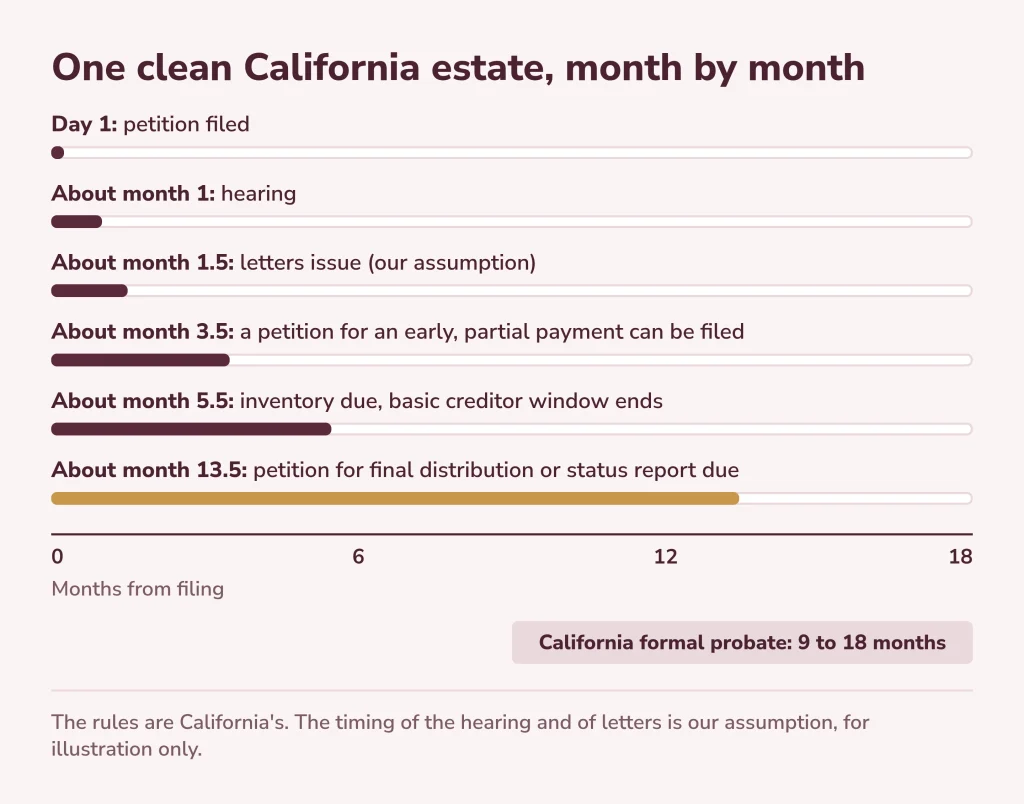
On those assumptions, even a clean California estate is unlikely to close much before six months, and the latest date for that first petition or report falls past a year. That fits the court’s 9 to 18 months.
What makes it take longer
- A will contest. Windows to start one differ widely: 120 days after the will is admitted in California (Prob. 8270), 3 months after service of the notice of administration in Florida (733.212), and two years after the will is admitted in Texas, or two years after discovery for forgery or fraud (Est. Code 256.204). Exceptions apply, for example for some incapacitated people. A suit can run well past that. We found no data on how long. See how a contest works.
- No will, or heirs who can’t be found. Someone has to work out who inherits before anything can be paid.
- Debts close to or above the assets. Paying in the wrong order has real risk. If an estate owes federal tax and can’t pay all its debts, 31 USC 3713(b) can make a fiduciary who knew of the tax debt personally liable for paying others first, up to the amount paid out, as the IRS manual explains. The manual also says courts have let certain costs, such as administration and funeral expenses, go ahead of the tax debt, but that a federal tax lien that arose before the death comes ahead of funeral costs. The manual is guidance for IRS staff, not law. If an estate may not cover its debts and owes the IRS, that’s the point to get a lawyer.
- A house, a business, or property in another state. Each can need its own sale, valuation or court step.
- A slow court or a slow executor. Closing times differ by county, as Oregon’s table shows, though the report doesn’t say why.
What makes it shorter
- Property that skips probate. Joint tenancy, trust property, and accounts with a named survivor or payee usually pass outside it, so they don’t wait on the court. California’s small estate count, for one, leaves these out (Prob. 13050). Check whether probate is needed at all.
- A small estate route. Many states have one, with a much shorter wait. California: an affidavit 40 days after death (Prob. 13100), gross value up to $208,850 for deaths on or after 1 April 2025 (form DE-300, with exclusions). Washington: 40 days after death and 10 days after notice to other successors, up to $100,000 net, for personal property (RCW 11.62.010). New York: no waiting period, $50,000 gross of personal property, filed with the Surrogate’s Court (SCPA 1301, 1304). All read 5 November 2026. See the small estate affidavit guide for other states.
- Filing soon, with papers in order. Most of the legal waits above count from letters, so they can’t start until someone files. Others run from the death whether or not anyone has filed, such as Ohio’s creditor period, Florida’s 2-year limit and the tax dates.
- Beneficiaries who cooperate. Signed waivers can cut steps, where the state allows it, as California does for the final account.
If you’re a beneficiary waiting to be paid
Early on, a wait usually means the process is working as designed. An executor who pays too early can put the money or themselves at risk. You can ask the executor which stage the estate is in and what’s left, and ask the clerk what has been filed. Our page on how long an executor has to pay beneficiaries goes through this in detail.
Some states have a way to get part of a share sooner. In California, a petition for preliminary distribution can be filed two months after letters (Prob. 11620), and the court orders it if it can be done without loss to creditors or injury to the estate or anyone interested (Prob. 11621). If a delay is the problem, California courts can reduce the executor’s or attorney’s pay when the time ran past what’s required, was within that person’s control, and wasn’t in the best interest of the estate or those interested (Prob. 12205).
It’s time to talk to a lawyer when a deadline is running, the will is disputed, you suspect fraud, the estate can’t cover its debts, a business is involved, or heirs are in conflict.
Your next step
If you’re the executor, call the probate clerk in the county where the person lived and ask three things: how long it now takes from filing to letters, whether your estate qualifies for a small estate route, and when the court expects its first report. Have the will, a death certificate and a rough list of assets and debts in hand. Then write your own dates on a calendar. Most count from the day letters issue, but some, such as the tax dates, count from the death. Selling the house and handing out belongings can wait until you have letters.
Sources checked on 5 November 2026.
Sources
- Oregon Judicial Department: State Trial Courts, Age of Terminated Cases 2025
- California Courts Self-Help: Formal probate
- California Probate Code 8003, hearing date
- California Probate Code 8110, notice
- California Probate Code 8270, revocation of probate
- California Probate Code 8800, inventory
- California Probate Code 9100, creditor claims
- California Probate Code 11620, preliminary distribution
- California Probate Code 11621, order for preliminary distribution
- California Probate Code 12200, time for closing
- California Probate Code 12205, reduced compensation for delay
- California Probate Code 13050, what the small estate count leaves out
- California Probate Code 13100, small estate affidavit
- Judicial Council of California: form DE-300 (Rev. 28 Apr 2025)
- Florida Statutes 733.212, notice of administration
- Florida Statutes 733.702, limitations on presentation of claims
- Florida Statutes 733.710, limitations on claims
- Florida Probate Rules 5.340, 5.400 and 5.401 (Florida Bar compilation, 15 Oct 2026)
- Texas Estates Code 51.053, service by posting
- Texas Estates Code 256.204, period for contest
- Texas Estates Code chapter 308, notice to claimants
- Texas Estates Code 309.051, inventory
- New York SCPA 1802, presentation of claims
- New York SCPA 1301, small estate definition
- New York SCPA 1304, voluntary administration
- New York EPTL 11-1.5, payment of legacies and shares
- Arizona Revised Statutes 14-3801, notice to creditors
- Arizona Revised Statutes 14-3933, closing statement
- Ohio Revised Code 2117.06, claims (read 5 Nov 2026 in the official Ohio code)
- Ohio Revised Code 2113.25, time for administration (read 5 Nov 2026 in the official Ohio code)
- Revised Code of Washington 11.62.010, affidavit for personal property
- IRS: Publication 559 (2025), Survivors, Executors, and Administrators
- IRS: Instructions for Form 706 (Rev. July 2026)
- IRS: Instructions for Form 1041
- IRS: Transcripts in lieu of estate tax closing letters (reviewed 29 Oct 2026)
- IRS: Internal Revenue Manual 5.17.13, insolvencies and decedents' estates