Letters testamentary are the court paper that proves you are the executor. A will can name you, but it doesn’t give you power over the estate. The letters do. To get them, you usually file the original will and a death certificate with the probate court in the county where the person lived. The court admits the will and appoints you, you take an oath, and the clerk issues the letters. Banks, title companies and the IRS may ask to see them before they deal with you.
This page is general information, not legal or tax advice. Estate law varies by state and changes. Ask the court clerk, or a lawyer or tax professional, about your case.
This page is part of our guide to the executor’s job. Executor Handbook sells nothing and refers no one.
What letters testamentary are
“Letters” here is an old legal word for a court’s written grant of authority. It isn’t correspondence, and it’s often a single page. The usual term is plural even then, so “letter of testamentary” and “letters of testamentary” are common slips for the same paper. In Texas, letters are a certificate of the clerk under the court’s seal stating that you qualified, the date you qualified and the name of the person who died. California requires the clerk’s signature, the court’s seal, the county, your name and your title.
The authority starts with the paper, not the will. California’s rule is plain: “A person has no power to administer the estate until the person is appointed personal representative and the appointment becomes effective,” and that happens when letters are issued. Minnesota says you must be appointed, qualify “and be issued letters”. New York defines an executor as “any person to whom letters testamentary have been issued.”
Some states protect useful steps taken earlier. California lets a named executor pay funeral expenses and take necessary measures to maintain and preserve the estate before appointment (Prob. 8400(b)). Minnesota and Florida say your powers “relate back” to cover acts before appointment that benefited the estate, and Minnesota lets a named executor carry out written instructions about the body, funeral and burial before then. That isn’t the same as authority to empty a bank account.
What your state may call them
Banks and courts use different words for the same idea. Here are the seven states whose rules or official forms we read on 5 November 2026. If your state isn’t here, the court clerk can tell you the local name.
| State | The paper | Who issues it |
|---|---|---|
| California | Letters, form DE-150, with boxes for testamentary, administration, administration with will annexed, and special administration | Superior court clerk |
| Florida | Letters of administration, even when there’s a will. Florida’s code says “All letters shall be designated ‘letters of administration.’” (Fla. Stat. 731.201) | The probate court |
| Massachusetts | Letters of Authority for Personal Representative, MPC 751 | Registry of Probate |
| Michigan | Letters of Authority for Personal Representative, PC 572 | Probate court: judge in formal cases, register in informal ones |
| New York | Letters testamentary. The court also issues a certificate of letters showing the appointment is still in force (SCPA 2402(11)) | Surrogate’s Court |
| Pennsylvania | Letters testamentary. The proof you hand out is a short certificate | County Register of Wills |
| Texas | Letters testamentary, in the form of a sealed clerk’s certificate (Est. Code 306.005) | Clerk of the court that granted them |
Letters testamentary vs letters of administration
The difference is where your authority comes from. Letters testamentary rest on a will that names you. Letters of administration rest on a statute that says who may serve. Both tell the outside world that the court has appointed you. Texas and California’s form sort them like this:
| Situation | What the court issues |
|---|---|
| A will names an executor who can and will serve | Letters testamentary |
| No will | Letters of administration |
| A will, but it names no executor, or the named executor has died or doesn’t serve | Letters of administration with the will annexed (often written c.t.a.) |
| Urgent need, or a dispute holding up the full appointment | Temporary authority under another name: special administration in California, preliminary letters in New York |
With no will, the statute sets the order, and it usually starts with the surviving spouse. See California, New York, Texas and Florida. Being named doesn’t guarantee appointment either. Felons are barred in Florida. Texas bars them too, unless they were pardoned, had their civil rights restored, or are named in the will and a court approves. Florida and Texas both limit nonresidents. Our guide to becoming an executor covers who qualifies. If you’d rather not serve, Massachusetts has a renunciation form; ask your clerk for the local equivalent.
When you need them, and when you don’t
You’ll usually need letters for anything the person held in their own name alone. A California court lists banks, title companies and tax authorities among those who may want certified copies. Federal agencies ask too:
- IRS. To get the person’s tax information you send a copy of the letters, or Form 56 with the letters attached, plus a copy of the death certificate. Form 56 for a court-appointed executor needs “current letters testamentary or a court certificate.”
- Savings bonds. TreasuryDirect asks for court evidence of your appointment, such as letters. It won’t return what you send, so send a copy.
- Medical records. HIPAA gives the personal representative access to the person’s health information. Offices usually want proof of who that is.
You may not need them at all. Accounts with a named beneficiary and jointly owned property often pass outside probate, as our page on what needs probate and what doesn’t explains. A modest estate may qualify for a small estate affidavit. New York issues a certificate of voluntary administration for small estates instead. Texas can admit a will as a muniment of title (a will used as proof of ownership) where the estate owes no unpaid debt other than liens on real estate, or the court finds no need for administration. Nobody gets letters that way, and the order itself is the authority people rely on.
How to get letters testamentary
The forms differ, but the order is much the same in the states we read. The state rules in these steps were read on 5 November 2026.
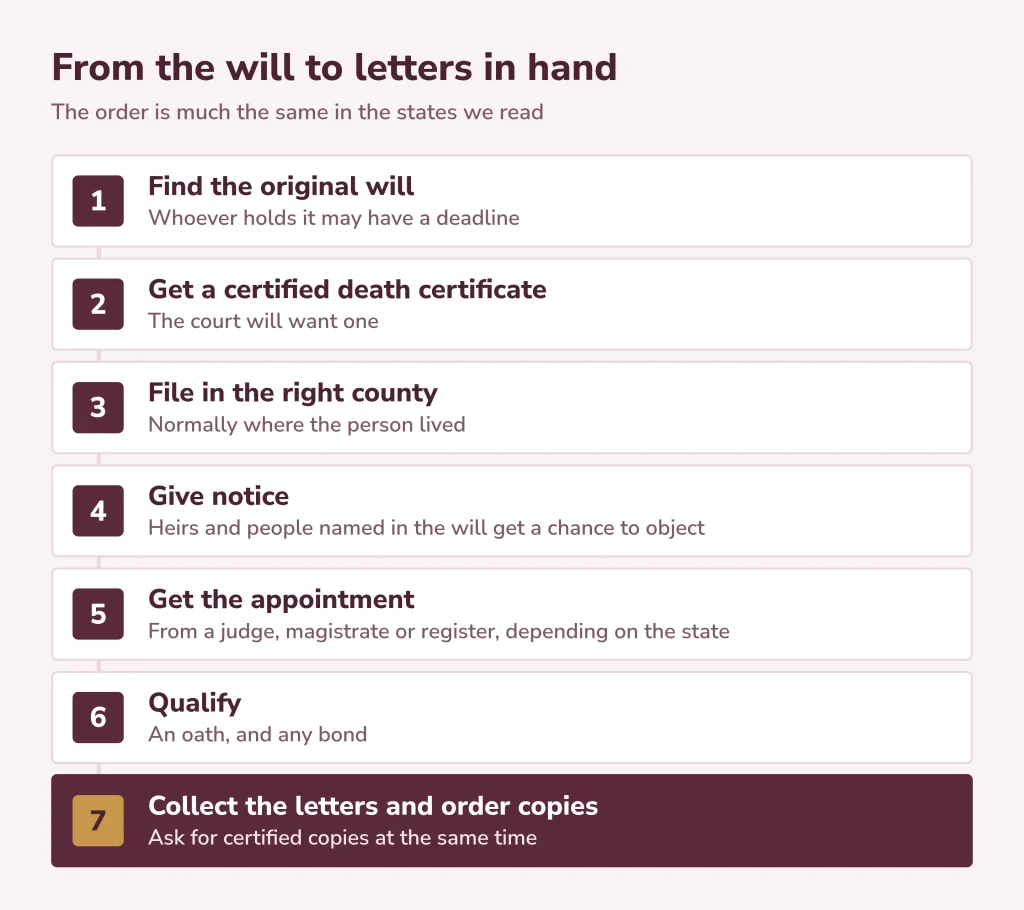
- Find the original will. Whoever holds it may have a deadline. In Florida it goes to the clerk within 10 days of learning of the death (Fla. Stat. 732.901). In California it’s 30 days from learning of the death, unless a petition is filed first (Prob. 8200). A photocopy is a harder path. Massachusetts sends a copy, or a will with handwritten changes, to a formal proceeding.
- Get a certified death certificate. The court will want one, and so will most institutions later.
- File in the right county. That’s normally where the person lived. California uses form DE-111. Massachusetts uses a packet built around MPC 150. New York has a Petition for Probate. In Philadelphia you complete the petition at an appointment, bringing the will, death certificate, an estimate of the estate’s value, a valid ID and the fee.
- Give notice. Heirs and people named in the will get a chance to object. California requires notice at least 15 days before the hearing (Prob. 8110), mailed by an adult who isn’t a party, plus newspaper publication. Massachusetts informal cases need written notice at least 7 days before filing (MUPC guide, section 3.13). New York sends formal court papers, called process, to the heirs and others (SCPA 1403).
- Get the appointment. A judge decides in a California hearing. An uncontested informal case in Massachusetts goes to a magistrate or judge as an administrative matter. Pennsylvania’s register grants letters.
- Qualify. California needs an oath and a signed acknowledgment of your duties before letters issue. Texas needs an oath or declaration and any bond. A bond is an insurance-like promise that protects the estate if the executor mishandles it. Many wills waive it, but a court may still require one: see California, Florida and Texas.
- Collect the letters and order copies. The clerk or register issues them, and you ask for certified copies at the same time.
Do you need a lawyer for this? It depends on the state and the court, and we didn’t read every state’s rule. California’s self-help page is written for people filing on their own. Ask the clerk whether your court accepts an executor filing without one. Court staff can explain forms and fees, but they generally can’t give legal advice; Philadelphia’s Register of Wills says so directly. Filing online depends on the court too. Massachusetts takes mail, in-person and e-filing. Philadelphia’s page describes an appointment at its probate office and also lists a virtual probate procedure.

How long it takes
No state we read sets a total number of days from filing to letters. The rules we read on 5 November 2026 set the steps around them:
| State | What the rule says |
|---|---|
| California | The hearing is set 15 to 30 days after filing, or 30 to 45 at your request (Prob. 8003). Letters issue after the order, oath and any bond, not necessarily that day. One county court says it “typically” takes four to six weeks after the death to appoint someone. That’s one court’s description, and calendars vary |
| Florida | No waiting period in the text we read. After letters, you promptly serve a notice of administration, and objections to the will run 3 months from service (Fla. Stat. 733.212). The Florida Probate Rules weren’t read |
| Massachusetts | An informal order can’t enter until 7 days after the death, or 30 days in most cases where the person lived out of state (MUPC 3-302, 3-303, 3-307, 3-308, as cited in the guide). Letters follow once the bond is approved |
| New York | Heirs get process, and objections are due by the return day it names, or a later day the court directs (SCPA 1410). We read no day count |
| Pennsylvania | Nothing we read sets a time. Philadelphia handles the petition at your appointment |
| Texas | The court’s notice, called a citation, is posted at least 10 days before the return day (Est. Code 51.053, 258.001). The court grants letters before the 21st day after the will is probated, though late letters are still valid (306.001). The oath can be taken before the 21st day after the order, or until letters are revoked for failure to qualify (305.003). The clerk then issues letters promptly (306.004) |
You’ll see tidy figures online, like “two to four weeks” or “four to eight weeks.” We looked for a statute or study behind them and didn’t find one. Ask the clerk what the current calendar looks like. An objection, a missing heir or a problem with the will can add months.
Two Texas clocks can cost a named executor the job. The court can appoint someone else if the executor fails to qualify before the 21st day after the will is probated, or doesn’t present the will before the 31st day after the death and the court finds no good cause (Est. Code 306.002, read 5 November 2026). Other states have their own rules, so ask early.
If something can’t wait, such as a house with no insurance or a business to run, ask about temporary authority. New York offers preliminary letters to a named executor once a petition is filed and process has issued, or earlier at the court’s discretion (SCPA 1412). They carry broad powers, but the court can limit them, they can’t pay beneficiaries, and a decree denying probate revokes them unless the court directs otherwise. California can appoint a special administrator when the estate needs someone at once (Prob. 8540). Massachusetts has a special personal representative, but only a formal court order can create one.
What it costs
The court’s main charge is the probate filing fee. Extra certified copies cost more. These are the figures we read on 5 November 2026. Other counties and states differ, and a county row stands only for that county.
| Place | Filing fee | Extra certified copies |
|---|---|---|
| California | $435, with some county variation (Statewide Civil Fee Schedule effective 1 Jan 2026, line 124) | $40 to certify a copy, plus $0.50 a page to prepare it (lines 187 and 189, the general court copy fees; ask the clerk) |
| Florida | Up to $395 for formal administration, plus a $4 service charge; recording is required and may cost extra, so ask the clerk (Fla. Stat. 28.2401) | $2 to certify, plus $1 a page to copy (Fla. Stat. 28.24) |
| Massachusetts, informal | $390, including the bond form, notices and the first Letters; newspaper publication is extra (MUPC guide, section 3.3.1) | $25 each (MUPC guide, section 1.12.4) |
| New York | $45 to $1,250, by the size of the estate passing under the will (SCPA 2402) | $6 for each certificate of letters (SCPA 2402(11)) |
| Texas, Harrison County | $445 (county fee schedule, 1 Jan 2026). We found no statewide total, so ask the clerk | $5 to certify, plus $1 a page, on the same schedule. State law lists a $2 fee to issue letters (Local Gov. Code 118.052) |
| Illinois, Cook County | $479 new-case fee. The same form lists a $250 appearance fee; ask the clerk whether it applies to you (CCP-0607, 10/01/25) | Not read; ask the clerk |
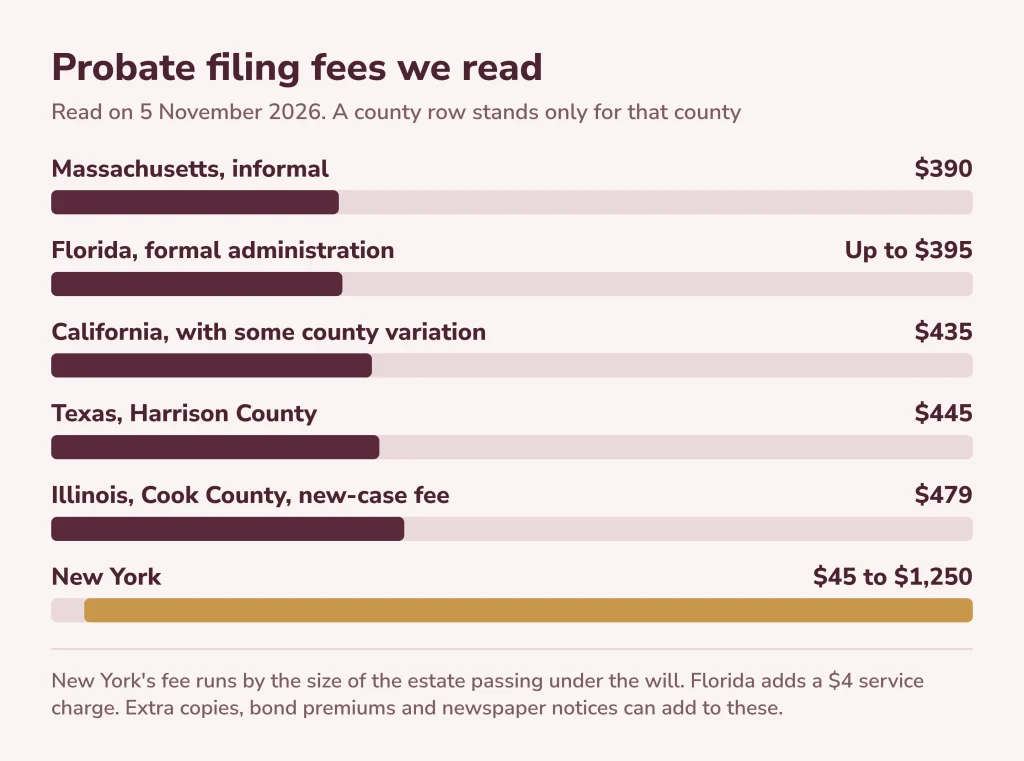
Bond premiums and newspaper notices can add to this, and lawyers’ fees can add far more. We found no reliable public figure for premiums or notices, so ask for a quote. Our probate cost estimate lets you enter your own numbers.
Copies, and how recent they must be
We found no rule on how many copies you need. Count the banks, brokerages, insurers and title companies you’ll deal with, and ask each one whether it keeps the copy. You can go back for more: Texas says the clerk issues any number of letters when requested.

In the rules we read on 5 November 2026, letters don’t go stale, but copies can. Massachusetts says it directly: “Letters do not expire, but third parties may require Letters to have been certified within the past 90 days.” That’s why a clerk’s dated certification matters. California’s form has the clerk certify that the letters “have not been revoked, annulled, or set aside, and are still in full force and effect.” New York sells a certificate saying the appointment is still in force. Michigan’s form has a similar line. The windows are set by whoever receives the paper, so 90 days in one place can be 60 in another: the Massachusetts Land Court wants a Letter of Authority not more than 60 days old for one kind of sale of registered land.
You may read that letters expire after a year in some states. We didn’t find that rule in the statutes we read, though we haven’t read all 50. Some letters do carry a date: California’s form has an expiry line for special administrators, and Michigan’s has a “These letters expire” line. Your authority also ends when the job does. In Minnesota, that’s one year after a closing statement is filed, or on a closing order or resignation.
Read your letters before you act
Letters can be limited, and the limit is printed on them. California’s form shows whether you hold full or limited independent authority. With limited authority you can’t sell real estate, grant an option on it or borrow against it without court supervision. The form also has a box saying you can’t take possession of money or other property without a specific court order. Michigan’s form can exclude the real estate or a business interest, and New York can grant limited and restrictive letters.
Letters give you power over the probate estate. They don’t change who gets accounts with a named beneficiary, and they don’t let you rewrite the will. Our page on what an executor can’t do goes through the limits. They also don’t, by themselves, make the estate’s debts yours. The CFPB says collectors may not imply you owe them from your own assets, with listed exceptions. One federal rule can reach you personally, though. Under 31 USC 3713(b), if the estate is insolvent and you know of a federal tax debt but pay others first, the IRS’s manual says you can be personally liable, up to the value of the assets paid out against its priority.
When to get a lawyer
Court staff generally can’t advise you on your case. These are the points where it’s time to talk to a lawyer:
- Someone objects to the will or to your appointment, or you suspect fraud.
- The original will is lost, or it has handwritten changes.
- You can’t find an heir, or an heir is a minor or can’t manage their own affairs.
- The estate may not cover its debts, or it owes the IRS.
- The person owned property in another state. That can take a second, ancillary case there.
- There’s a business, or the heirs are in conflict.
- A deadline is running and you can’t meet it.
Your next step
Find the original will and order certified death certificates. Then call the probate court clerk in the county where the person lived and ask:
- What is the petition called, and can I file it myself?
- Is there a hearing, and what’s the earliest date right now?
- What’s the filing fee, and what does each certified copy cost?
- Will I need a bond, given what the will says?
- Who has to get notice, and is newspaper publication needed?
Closing accounts, selling property and paying beneficiaries can wait until you have letters, and they’ll have to. Once you do, the next jobs are an EIN for the estate, an estate bank account, and the rest of the job in order.
State rules here were read in the linked statute, court page or official form. We didn’t read every state, and fees change, so confirm them with the court.
Sources checked on 5 November 2026.
Sources
- California Probate Code 8400 (official text, read 5 Nov 2026)
- California Probate Code 8403, 8404, 8405 (official text, read 5 Nov 2026)
- California Probate Code 8461 (official text, read 5 Nov 2026)
- California Probate Code 8003, 8110, 8200, 8481 (official text, read 5 Nov 2026)
- California Probate Code 8540 (official text, read 5 Nov 2026)
- California form DE-150, Letters (read 5 Nov 2026)
- California Courts self-help: Formal probate (read 5 Nov 2026)
- Superior Court of California, Statewide Civil Fee Schedule, effective 1 Jan 2026 (read 5 Nov 2026)
- Superior Court of California, Contra Costa County: Decedents' Estates (read 5 Nov 2026)
- Florida Statutes 731.201 (read 5 Nov 2026)
- Florida Statutes 733.301, 733.303, 733.304 (read 5 Nov 2026)
- Florida Statutes 733.402 (read 5 Nov 2026)
- Florida Statutes 733.601 (read 5 Nov 2026)
- Florida Statutes 733.212 (read 5 Nov 2026)
- Florida Statutes 732.901 (read 5 Nov 2026)
- Florida Statutes 28.2401 (read 5 Nov 2026)
- Florida Statutes 28.24 (read 5 Nov 2026)
- Massachusetts Probate and Family Court, MUPC Estate Administration Procedural Guide: Informal Proceedings (updated 23 Sep 2026, read 5 Nov 2026)
- Massachusetts Probate and Family Court, MUPC Estate Administration Procedural Guide: General Considerations, section 1.12 (read 5 Nov 2026)
- Massachusetts Land Court, Memo on Guideline 14 (read 5 Nov 2026)
- Michigan form PC 572, Letters of Authority for Personal Representative (Rev. 2/13, read 5 Nov 2026)
- Minnesota Statutes 524.3-103 (read 5 Nov 2026)
- Minnesota Statutes 524.3-701 (read 5 Nov 2026)
- Minnesota Statutes 524.3-610 (read 5 Nov 2026)
- New York SCPA 103 (read 5 Nov 2026)
- New York SCPA 702 (read 5 Nov 2026)
- New York SCPA 1001 (read 5 Nov 2026)
- New York SCPA 1403 and 1410 (read 5 Nov 2026)
- New York SCPA 1412 (read 5 Nov 2026)
- New York SCPA 2402 (read 5 Nov 2026)
- New York Courts: Richmond County Surrogate's Court Procedures (read 5 Nov 2026)
- New York Courts: Petition for Probate form (read 5 Nov 2026)
- Pennsylvania 20 Pa.C.S. 3155 (read 5 Nov 2026)
- City of Philadelphia: Begin the probate process (with a will) (read 5 Nov 2026)
- Montgomery County, Pennsylvania, Register of Wills FAQ (read 5 Nov 2026)
- Texas Estates Code chapter 51 (read 5 Nov 2026)
- Texas Estates Code chapter 257 (read 5 Nov 2026)
- Texas Estates Code chapter 258 (read 5 Nov 2026)
- Texas Estates Code chapter 304 (read 5 Nov 2026)
- Texas Estates Code chapter 305 (read 5 Nov 2026)
- Texas Estates Code chapter 306 (read 5 Nov 2026)
- Texas Local Government Code chapter 118 (read 5 Nov 2026)
- Harrison County, Texas, County Clerk Fee Schedule, 1 Jan 2026 (read 5 Nov 2026)
- Cook County Clerk of the Circuit Court, form CCP-0607 (10/01/25) (read 5 Nov 2026)
- IRS: Deceased taxpayers, getting information from the IRS (read 5 Nov 2026)
- IRS: Instructions for Form 56 (read 5 Nov 2026)
- IRS: Internal Revenue Manual 5.17.13 (read 5 Nov 2026)
- TreasuryDirect: Court-appointed representatives (read 5 Nov 2026)
- HHS: Health Information of Deceased Individuals (read 5 Nov 2026)
- CFPB: Does a person's debt go away when they die? (reviewed 15 Oct 2026, read 5 Nov 2026)